
WHAT ARE YOUR BASIC ASSUMPTIONS ABOUT LIFE?
Article by LiveReal Agents Thomas and Kevin
We all have basic assumptions about life.
“Assumptions” can act like the foundation of a building.
They serve as a basis that other things are built on.
But instead of a physical building, what rests on our foundation of assumptions is our system of core beliefs. It’s a “ground floor” of “the self.” It’s like the operating system of our minds.
Like any operating system, it usually runs in the background.
We often don’t pay attention to it.
We've typically never been trained to examine it, speak its language, or even know it exists.
Yet it determines most of what we think, feel, see, and do.
It’s fashionable today to hear things like "I’m seeing this through the lens of X or Y…” or “From the perspective of X, I think Y…”
That points toward the “foundation.” It’s the “lens.” It doesn’t describe what we see, but “the lens we see through.”
Math, physics, chemistry, all social sciences, and essentially all formal systems begin with some sort of bedrock, a fundamental origin or starting point.
These foundations act as a basis for everything that follows. All subsequent designs, decisions, and calculations are based on them.
We describe these starting points with different words.
In math, it’s an “axiom,” “postulate,” or a “given.”
In philosophy, it’s a “first principle,” “presumption,” “given,” “a priori term” or “assumption.”
In formal argument or drama, it’s a “premise.”
In engineering or construction, it’s “bedrock.”
In theology, there are “presuppositions.”
In music, it’s a “motif.”
In day-to-day life, the word “assumption” is probably the term we’re most familiar with.
Others might call it the “basis,” “ground,” or “assertion” in a proposition.
These different words point roughly toward the same basic principle.
It’s the trunk and root structure of the tree. Every branch, leaf, and twig is “predicated” on that trunk.
Thousands of years ago, Archimedes supposedly said that he could lift the Earth off its foundation if he were given a place to stand, one solid point, and a long enough lever.
Philosophy has recently been searching for an “Archimedean point” in its search for certainty.
Descartes, for example, referred to it in his search for a reliable starting point to reason from.
More recent philosophers have spoken about the idea of a “God’s-eye view” – a viewpoint from which we can perceive objective truth.
(Quick aside: It’s been fashionable recently in some circles to describe philosophy as merely the servant of science. But the scientific method relies on a substructure of philosophical propositions. Philosophy lies at the heart of science. (The idea that empirical observation, questioning, hypothesizing, experimenting, analyzing data, interpreting results, drawing inductive conclusions, peer-reviewing and so on will lead to valid results about the world, etc. – is a philosophical idea. The process itself starts with a hypothesis, which typically comes from an educated intuition or - put bluntly - imagination. (Einstein: “Imagination is more important than knowledge.”) The entire procedure rests on a few givens, such as the idea that “the laws of nature are consistent,” “our senses and memory are basically reliable,” and so on.))
Some imagine that “we should have no assumptions.”
They confuse it with bias.
They sometimes imagine that they as purely neutral or “objective” while everyone else is skewed.
But assumptions are inevitable. It’s impossible to have a building with no foundation. ("We'll build the second and third floors on up, but this building won't have a first.")
Even the idea that “we should have no assumptions” is an assumption.
“Bias” describes a situation where someone has hidden or unconscious assumptions. They try to hide those assumptions while pretending to be perfectly “objective.”
But everything starts somewhere.
These starting points are critical.
When applied to our lives, there’s often a classic “mother ship/clone dynamic” involved.
We’ve seen it in movies like Independence Day, Star Wars Attack of the Clones, The Avengers, The Matrix Revolutions, etc.
The basic idea is that there’s a “mother ship,” and an overwhelming number of enemy “clones.”
The story inevitably reaches a point where all seems lost. The heroes are going to lose.
But then, someone takes out the mother ship, and suddenly, the clones become dysfunctional.
In the same way, certain everyday problems are like “drones.”
Those everyday problems are connected to a philosophical “mother ship.”
That philosophical assumption or problem “trickles down” to swarms of everyday problems that are further downstream. If you solve the central philosophical problem, many other solutions will follow automatically.
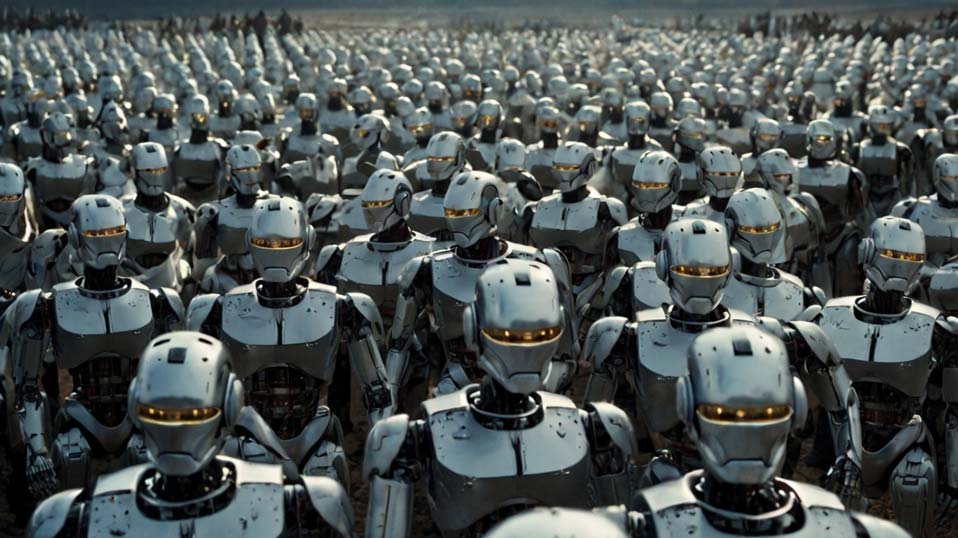
That “mother ship” is a philosophical assumption.
If your initial assumption is off, everything that follows will likely be off as well.
For example, if an initial assumption is “everyone’s out to get me,” then everything beyond that point might be entirely logical and reasonable. The result will still be a state of unnecessary paranoia.
If someone assumes “I am Napoleon!” or Julius Caesar or Jesus, it could lead that individual toward being heavily medicated or institutionalized.
If an initial assumption is that “life is meaningless,” several predictable results could follow as a result, such as depression, a general mood of nihilism, and if that sort of state is allowed to freely run its course on a widespread scale, civilizational collapse.
Other examples are less extreme.
A few more common examples of core axioms:
• “The purpose of life is to enjoy yourself.”
• “The purpose in life is to leave the world better than we found it.”
• “There is no ‘God’”
• “Everything is God”
• “The Bible is the Word of God.”
• “Science is the only way to truth.”
• “Nobody knows anything.”
We might acquire these assumptions at great cost or casually. They might seep in through song lyrics, or they might have been drilled into us as children. They might have been etched into us through trauma or they might have simply been catchy movie lines.
But when they become key components of a life philosophy, they can become load-bearing pillars that carry our lives. They lead to whatever “game of life” we play.
They can act as seeds of initial starting points that can lead to tremendous consequences.
An old parable illustrates this.
It goes something like this:
For want of a nail the shoe was lost.
For want of a shoe the horse was lost.
For want of a horse the rider was lost.
For want of a rider the message was lost.
For want of a message the battle was lost.
For want of a battle the kingdom was lost.
And all for the want of a horseshoe nail.
The smallest change (the lack of a nail) can lead to a huge result (the loss of an entire kingdom).
Another depiction is “the butterfly effect.”
“The flap of a butterfly’s wings in Brazil can set off a tornado in Texas.”
This absurd-sounding “butterfly effect” stems from chaos theory, a branch of mathematics (a field not known for absurdity).
But again: a small change in system conditions at one point can lead to dramatic consequences in that system at another point.
Another example: microscopic differences in the starting point of a swinging pendulum can quickly lead to huge differences. In the beginning, they might seem perfectly in sync. But before long, those nearly-invisible differences will lead to them becoming wildly and obviously out of sync.
Here's an example.

We could look at another example in math.
Imagine we’d start by assuming a single axiom.
Axiom: 3+3=7
From that point, we could subtract 6 from both sides.
We’d then wind up with the conclusion that 0 = 1.
We could then multiply both sides by, say, a billion, and we’d wind up with the answer that zero equals a billion.
Everything beyond that point would be both provable and meaningless.
Call it "mathematical nihilism."
The moral of the story? Starting points are critical.
Yet few of us ever pause to examine our initial assumptions.
We typically make assumptions and then act on the basis of those assumptions without ever examining those initial ideas that started it all.
We often see this in arguments.
Two people, pre-loaded with hundreds of unspoken, unconscious assumptions, jump into a conversation, and kick around a few bumper-sticker platitudes based on widely differing perspectives, belief frameworks, and data sets, (in short, worldviews) all of which exist dozens of steps down a particular logic trail. Then they wonder why they can’t agree, and how the other person can be so absurd, dumb, ignorant, or evil.
We often see the hidden assumptions of others clearly.
But we’re often blind to our own.
It’s the psychology of the blind spot, or the “splinter in your eye, log in my own” effect.
Human beings can be strangely incurious about the “code” in our minds and hearts. It’s as if one of the basic assumptions in our programming is “Don’t know thyself.”
August Turak once suggested a thought experiment to demonstrate this.
Imagine one day you made a discovery: hidden inside your brain was a computer chip, apparently implanted long ago. The programming in that chip governs nearly everything you think, feel, see, and do.
How would we respond?
Some would deny it exists.
Others would simply allow the program to run (that is, they’d allow it to continue running them) and just try to make things as comfortable as possible throughout.

Others would become a seeker. They’d start asking questions.
Who or what created that chip? Who wrote the software? Why did they write it? What is it programmed to do? How was it programmed? Does it have my best interests in mind? What control do I have in this? Can I reprogram it?
This scenario might seem far-fetched.
But we have been programmed. Our genes, teachers, friends, professors, commercials, movies, songs, politicians, laws, billion-dollar corporate marketing departments, all “program” us in real life. From nudging, arguing, and modeling all the way through pressure and coercion – they often shift our thinking with storehouses of ideas through an array of methods.
But what’s the point?
We probably aren’t interested in creating tornados in Texas, or keeping pendulums in sync, or (hopefully) seeking out a nail that will undo a kingdom.
How we can apply this to ourselves?
How does this affect the way we see the world?
What’s the “bedrock” of our thinking?
Where in ourselves is that all-important nail the saves or loses a kingdom?
What’s the Archimedean point within ourselves?
What are the “butterfly’s wings” in our minds?
Does something like this even exist?
Are there initial conditions in our own thinking that can lead to dramatic consequences later in our lives?
Are there seemingly microscopic differences in certain ideas we adopt or assumptions we make that can chart a new course through life?
If our minds work like computers, where’s the source code?
What is our mental or emotional “operating system”?
What is the underlying framework all other programs (thoughts, ideas, feelings, behaviors) are built on?
We often hear promises that something will “change your life.” That “change” is sometimes described as if it’s an accessory, like a necklace we can easily add to an outfit.
But a deeper sort of change doesn’t mean the swapping of an accessory. It means change from the bone marrow out. It doesn’t start from the outside, but from the inside. It isn’t mere “change,” but full transformation.
But transformation from inside-out means “getting inside yourself” first.
We don’t fix a car by standing beside it, or even from behind the steering wheel. We pop the hood, where we have access to the engine. On a computer, it’s like accessing the control panel or source code instead of just icons presented from the interface.
Where’s the “control panel” within ourselves?
Without access to that, our efforts could be like clicking a computer mouse that isn’t connected. However furiously we might click, nothing happens.
How do we connect up?
How do we drill down to mental bedrock, or access the source code?
How do we “get at” the basic axioms of our mind?
There are several answers here.
For practitioners of psychoanalysis, their answer is talk therapy. For meditators or yoga practitioners, their answer is meditation or yoga. For those who explore psychedelics, their answer lies in shrooms, LSD, or microdosing. For those who pray, the answer is prayer. Artists or athletes can sometimes do it through art or sports. There are many alternative therapies, bodywork and so on that claim to do this, with varying degrees of success.
For some, basic beliefs that are conscious, meaningful, and verbal. They can be put into words and act as the premises for a “code to live by.” (For Forrest Gump, for example, they took the form of what “Mama always said…” – words Forrest would live by.)
Each of these approaches has strengths and weaknesses.
But one alternative rarely gets much attention.
It’s neither the best or worst as compared to the above.
But it rarely gets much attention. In fact, it’s sometimes actively discouraged.
The method presented here is simply to ask, and answer, the very simple, basic, “Big Questions” of life.
What’s it all about? Who am I? Why am I here? Where did I come from? Where am I going? How do I know? How should I live? What’s the point? What the heck is going on?
…and so on.
The basic idea is to get in shape philosophically. (Call it “existential fitness.”)
It involves deliberately connecting up these questions and answers, our conscious thoughts, ideas, and feelings, and our day-to-day actions.
It could be described as the individual working to connect our heart, mind, and soul.
Life confronts each of us with existential riddles.
And like the inner Sphinx we all face, it demands answers.
We might answer verbally. But even if we don’t answer with formal, reasoned arguments or even with fully articulated words, we answer with our actions and the way we live.
But we all have a metaphysics, an epistemology, a teleology, a psychology, a code of ethics. Even if we don’t consider ourselves to be philosophers, we all have an answer to “What is the world?” (metaphysics), “How do we know?” (epistemology), “What’s the point?” (teleology), “Who or what am I?” (psychology), and “How should I act?” (ethics).
And our answers are interconnected.
If we decide on a single answer in our metaphysics (or “what the world is”) with a certain answer, then other dominoes naturally fall from there. At that point, our answers to many other key questions – including what we are, what we should do, and what the point is (psychology, ethics, and the meaning question) get answered automatically. The results can follow like dominoes.
Here’s an example.
Imagine someone’s answer to metaphysics (“What is the world?”) is that “the universe is basically an accident.” This initial answer leads to subsequent pieces falling into place. If we follow the logic, we’d soon realize that we are also accidents (since everything in the universe is an accident, and we are part of the universe, as our psychology), and therefore, it doesn’t matter what we do (ethics), and there is no meaning (teleology). It would become a worldview or life philosophy of nihilism.
Or, if we’d decide that the universe is a creation of an infinitely wise and infinitely loving Creator, then the assumptions about who we are, what we should do, and what the point of it all would similarly follow.
There are other variations along these lines. The above are just two examples.
But the process is generally the same throughout.
Once you land on an answer to the question, in so many words, of “What’s going on?” or “What is the universe?” – metaphysics – then then rest follows. The direction of the “trickle” flow is from metaphysics on – through psychology and epistemology down to teleology and ethics.
It’s no coincidence that the two basic answers above deal with the nature of reality.
Would you say reality is chaos? Then your life philosophy will be nihilism.
Would you say reality is a creation of the Judeo-Christian God, who is infinite, eternal, transcendent-yet-immanent, all-powerful, all-knowing, all good, and so on? Then your life philosophy will be theism. At least in theory, God becomes the center of everything, the source and the summit, the origin and the goal, the Big Answer.
Would you say on these topics, simply, “I don’t know”? Then your life philosophy would be agnosticism.
Would you say that we can’t say much about ultimate reality, but we’re tasked with choosing and creating meaning and order for ourselves? Then your life philosophy will be existentialism.
And so on. Those are a few examples of core assumptions about life.
Our basic answers lead to our life philosophy, or the code we live by.
The process of asking the Big Questions and articulating our basic answers to them flushes out our core assumptions about life.
It leads to “thinking life through.”
Having assumptions also isn’t a bad thing. They’re unavoidable. (Again, even the assumption that we shouldn’t make assumptions is an assumption.)
The trick lies in becoming aware of them.
Once again, this directs us to “know thyself.”
Some core assumptions are conscious – eg, “I am an environmentalist,” “I am a Christian,” “I am a Marxist,” “I am a playboy,” etc. A deliberately adopted belief system leads to an identity (and the reverse – an identity leads to a belief system) and is woven into the fabric of everyday life.
It’s our unconscious assumptions that can get us in trouble.
If I think of myself as a vegetarianism while regularly eating hamburgers, or that I’m a kind and loving person while consistently treating people like garbage, or that “there is no such thing as truth” while acting quite certain about a number of topics…I might at some point discover that my beliefs and actions are in a state of contradiction.
Contradictions indicate a problem.
We intuitively sense that something’s wrong. It violates one of the basic principles of logic, that “A=A,” or the “law of identity.” Psychologists call it “cognitive dissonance.” That condition can lead to a fragile life philosophy, and ultimately, an existential crisis.
Sometimes, our mind is full of contradictory ideas. (This condition can come easily in today’s environment where we’re flooded with media).
If we’re constantly shifting our core life philosophies, or living in a way that isn’t consistent with a single coherent code, it can be like driving with one foot on the gas and another on the brake, or listening to three or four songs at once. It can become a draining grind filled with friction and existential vertigo.
But there is a way out of this condition.
It’s natural.
It doesn’t require expensive surgery, pills, or doctor visits. It’s totally within our control.
What it requires is existential courage and some hard thinking.
Making “the code we live by” conscious, and striving to live by that code, is a good thing.
An unconscious life philosophy can mean structural problems in one’s map of the world that go undetected.
The other trick lies in making it stronger.
Our basic assumptions might be conscious. But they might also be incoherent, or inconsistent, or in some form or other that makes the ground of our knowledge fragile, or structurally unsound.
A coherent and consistent life philosophy, on the other hand, can mean a sense of confidence and stability that comes from having an accurate map.
The willingness to bring assumptions to light – and abandon them if they prove incoherent or untrustworthy – requires a certain amount of pluck. The easier route is to just let things be.
Few of us have been taught how to examine our life philosophy and test it for structural sturdiness.
But we can examine a life philosophy the way a doctor examines a patient.
Examining a life philosophy is a skill.
It’s a skill worth practicing.
If we reach a phase in the Existential Lego Set of our lives that develops into an existential crisis, we might sometimes decide that we need to bite the bullet and take a few steps back in order to ultimately move forward.
A skillful eye can also detect structural weaknesses. After that, it can prevent them from ever reaching a crisis level.
That can be preferable to suddenly waking up to a late-level, Stage Four existential crisis itself.
This direction uncovers a path to steer clear of a lot of unnecessary suffering.
In this direction lies a sense of genuine freedom.
It’s also an area of life where we have control.
We can stop wasting time fighting clones, and instead, direct our efforts at the mother ship.
We aren’t merely programmed robots passively carrying out predetermined scripts.
Or at least, we don’t need to be.
We have the potential to write scripts.
We aren’t mere characters fated to live out a pre-written story. We can examine our scripts, and if we choose, revise them.
We’re also authors – at least to some degree – able to write the story we’re living.
The challenge, then, is to start writing, and author well.