
WHY WE'RE DROWNING IN INFORMATION, YET STARVED FOR KNOWLEDGE
Article by LiveReal Agents Grace and Thomas
We’re drowning in information, but starved for knowledge.
The situation echoes the famous Coleridge line (slightly misquoted) about thirsty sailors stranded in the ocean:
“…water, water everywhere,
Nor any drop to drink.”
T. S. Eliot famously asked the question:
“Where is the knowledge we have lost in information?”
We seem to live in a strange condition of starvation-amid-overload. We have way too much information, gushing in from every possible corner – yet also, somehow, not enough. Not enough of the right kind.
Despite seemingly limitless amounts of information, we still haven't solved our problems - including the problem of "information overload."
Some might say “our knowledge-making system is broken.”
Some seem to think we’ll solve our information-overload problem with more information.
The idea is that if we get more information on “how to deal with information overload,” that key piece of the puzzle will solve the problem.
But strictly speaking, that “key piece” wouldn’t be mere “information.”
It would be “meta-information,” or information about information.
It would be something on an entirely different level.
Eliot might say the real word for it is “knowledge.”
That would mean “knowledge” isn’t a mere pile of facts.
We often think knowledge is a function of quantity.
With this model, the bigger the pile of facts, the greater the knowledge. “Those with the biggest piles are the smartest.”
That’s the “Sherlock Holmes model” of intelligence – that the smartest folks simply have more facts at their disposal than the rest of us.
That model would work if life was a game of Jeopardy or Trivial Pursuit.
If that were the case, an education model based on dumping a tsunami of meaningless facts into young brains might be effective.
It isn’t, of course. That system of education adopts “The Way of C-3PO,” or C-3PO-As-Role-Model – billions of facts at his disposal, able to chatter nonstop (over 6 million forms of communication), always ready to chime in with semi-relevant factoids such as the grim odds of surviving a trip through an asteroid field or declare “We’re doomed!”
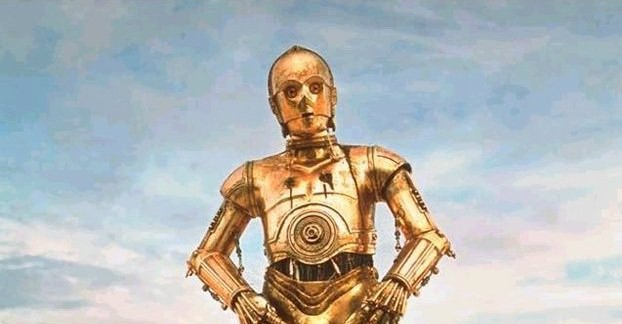
But he’s not known for heroic actions, penetrating insights, or even knowing what’s going on much of the time (antagonizing his cohorts when they’re on a mission to deliver a message to a Princess and save the Rebellion). It’s the archetype of the disjointed intellect.
Many of us sense the problem here.
Our models of information, knowledge, and intelligence seem somehow out of date, ineffective, and out of touch with real life. We seem to be deliberately cultivating societies of C-3POs. Living amid looming mountains of information might not be making us smarter, but more misinformed. We’re teaching and learning everything but what is most essential.
Life itself can seem unusually tricky and overwhelmy these days. We’re in a strange condition where knowledge just isn’t working the way it once did.
We might notice a few symptoms of this.
Nine “symptoms,” for example:
• Everyone seems to disagree
• Everyone seems to disagree with everyone else
• Everyone seems to disagree with everyone else about everything
• In the rare events when people engage in dialogue, they often “talk past each other”
• People often misunderstand others and feel misunderstood by others
• People then often dismiss each other as dumb, ignorant, crazy, or evil
• There's often a constant, underlying, low-grade fever of confusion seemingly everywhere
• There’s such pervasive uncertainty on Big Questions that they’re hardly even asked, and when simple, basic, obvious, Big Questions are asked, they’re seen as out-of-left-field bizarre, penetratingly disruptive, or revolutionary, Emperor’s-New-Clothes-style
• The above state of uncertainty can lead to strange counter-reactions of pseudo-certainty, where people become increasingly dogmatic, defensive, close-minded, and even hostile when anyone questions their version of the story.
This state of affairs doesn’t tend to foster happy family lives, functional relationships, an able citizenry, or an ability to stave off civilizational collapse.
In fact, it can make life seem like a floor covered in banana peels.

When everything is slippery, there’s no solid ground, and so there’s constant uncertainty.
As the saying goes, “our feet are firmly planted in mid-air.”
When conversations reach any deeper than the weather, celebrity gossip, or the latest outrage, we often seem to have difficulty communicating.
What’s going on?
Where did these banana peels come from?
If we really want to explore the answer to this, several factors are involved.
To name just a few: there’s the internet, of course (which didn’t exist until recently). There’s media, and it’s increasing dominance in our lives. There’s social media and its toxic effects. There’s AI, deepfakes, and valid reasons to sometimes distrust our own eyes and ears. There’s been a collapse of faith in objectivity itself. There’s the erosion of culture and its replacement by mass crowd-control. There’s the widespread destruction or transformation of traditions, authorities, identities. And so on.
But one key part of the problem seems especially critical.
It’s a single underlying dynamic that wears a thousand disguises.
The problem is philosophical.
Call it a “broken epistemology.”
“Epistemology” is “the study of knowledge” in philosophy.
Its basic question is, “How do we know?”
It’s often similar to physical health or the operating system on our computer; it’s invisible as long as it works, and we only notice it when it stops working smoothly.
And it’s stopped working smoothly.
Part of the equation is skepticism, or the doubting of knowledge.
There’s a healthy skepticism (which can lead to knowledge), and toxic skepticism (which can lead to chronic uncertainty).
Toxic skepticism is a philosophical problem.
Philosophical problems must be solved on a philosophical level. In other words, this condition – assuming we’re on the right track – won’t be solved by technology, apps, pills, politics, celebrities, or some group of geniuses in a laboratory or on a committee or in a smoke-filled backroom.
Our epistemology is broken, or at the very least, buggy.
Perhaps our knowledge-system has mutated into a malignant strain of toxic skepticism that’s now running rampant.
What’s happened? How did we get here?
We can follow a trail of clues.
Those clues will eventually lead to a story about a man stuck in a swamp.
But first, let’s back up a few steps and lay down some non-banana-peel groundwork.
As Walter Truett Anderson once noted:
“…we do not comprehend what a stunning – and yet still incomplete – upheaval of thought has occurred in the recent historical past.”
How can we understand this recent “upheaval of thought.”
Let’s imagine the following scenario.
You make a simple claim or assertion. For example:
“It’s going to rain tomorrow.”
Now, imagine you state this within earshot of someone we’ll call “Dr. McSkeptic.”
The fine doctor responds by asking some questions.
Are you sure it’s going to rain tomorrow?
How do you know it’s going to rain tomorrow?
Do you have evidence?
What is your evidence?
How do you know your evidence is valid?
Fair enough. “Statement, meet wall of skepticism.”
Dr. McSkeptic can reduce your assertion to uncertainty fairly easily.
He could demote your assertion to merely educated speculation, or in other words, a “guess,” relatively easily.
Of course, you might decide to mount a vigorous defense that “It really will rain tomorrow, and here’s why!” and present a thousand solid reasons. We could even say you’re a professional meteorologist with mountains of evidence and more PhDs than fingers.
But that fine doctor could always say, “I’m not convinced.”
Of course, predicting the weather is notoriously difficult, which means reducing that particular statement to uncertainty isn’t difficult.
But let’s imagine something even simpler and easier.
Imagine we state that “puppies are awesome.”
Everyone “knows” this.
But imagine we find ourselves facing the dreaded Dr. McSkeptic yet again.
The fine doctor will kick into gear:
What do you mean, exactly?
Define “awesome” with specificity and precision.
How do you know puppies are “awesome”?
What’s your evidence for that?
What if the puppy isn’t really awesome, but only seems to be?
Before long, even the most obvious statement in the world poofs into a cloud of mist.
The moral of the story: even a statement as clear and obvious as “puppies are awesome” can be reduced to a state of shadowy uncertainty.
The problem isn’t merely that even the most obvious statements are regularly reduced to uncertainty. The problem is that they often can be, and they often are when it really matters.
And here’s the kicker: if statements as simple, straightforward, and obvious as these can be reduced to uncertainty, what hope do we have when it comes to immensely complex topics such as politics, culture, religion, and spirituality?
We need to look deeper.
What’s happening here, exactly?
On the one hand, it might be easy to aim too narrow (and just say, “Avoid people like Dr. McSkeptic”) or too broad (and declare that we’re living through The Death of God or undergoing a slow-motion civilizational collapse that are the effects of greater forces beyond our control.)
But there’s also a more concrete and somewhat manageable explanation.
We can accidentally use this dynamic against ourselves.
We can embrace this epidemic of toxic skepticism when it’s useful to us – that is, when we can direct it toward those we disagree with. But we don't like it being unleashed on a broader scale, and when it can turn against us. We can love to sic Dr. McSkeptic on others, but then rarely turn his skepticism toward ourselves. It’s a way to weaponize against everyone else’s ideas while insulating our own.
This also risks translating into a situation where the best people are skeptical toward themselves while the worst suffer from a total lack of self-awareness.
W. B. Yeats once said it well:
“The best lack all conviction, while the worst
are full of passionate intensity.”
Or Bertrand Russell:
“The fundamental cause of the trouble
is that in the modern world the stupid are cocksure,
while the intelligent are full of doubt.”
(The above broadly refers to the Dunning-Kruger effect – a cognitive bias where individuals with low ability in a given area tend to overestimate their competence while those with high ability often underestimate theirs.)
But again, what’s causing this state of affairs?
This condition seems to be fueled by a “crack in our cosmic egg,” or philosophical fault line that’s ruptured the ground of our thinking, causing it to spew forth avalanches of banana peels.
This dynamic becomes a key piece of the engine of what we could call the “Confusion Industrial Complex.”
And here arrives the “Munchausen Trilemma.”
It’s based on one of the fantastical stories about the beloved character of Baron Munchausen.
One day, Baron Munchausen got stuck in a swamp.
Luckily, he escaped.
How?
He pulled himself out by his own hair.
This episode became part of a popular anecdote in modern philosophy.
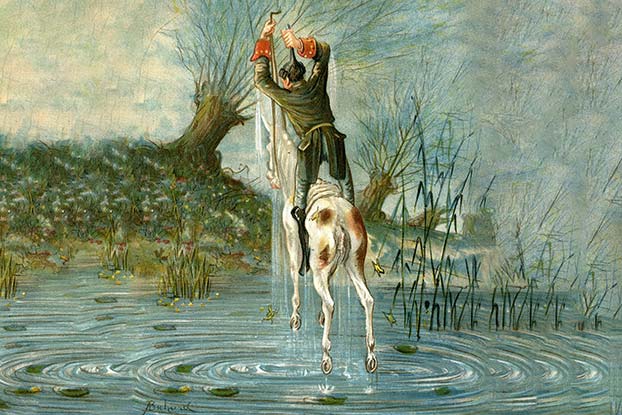
The “Munchausen Trilemma” points to the tricky business of justifying claims.
It can shed light on the difficulty of justifying even the most obvious claims like the above, that “puppies are awesome.”
Every claim – especially in today’s weird, funhouse-mirror world – potentially faces a barrage of corrosive skepticism, such as with withering fire from Dr. McSkeptic.
How can we defend our claims – any claims – against a relentless wave of toxic skepticism which demands that all claims be thoroughly justified? In other words, how do we justify our beliefs or knowledge claims in a way that avoids pitfalls?
To justify any claim, we need criteria to help us measure whether a claim can be considered true.
But what are those criteria?
What yardstick can we use to measure a claim, and to divide the “true” from the “doubtful”?
Here’s where things can get especially slippery.
Baron Munchausen “provided his own criteria” in the sense that he “pulled himself out by his own hair” – a feat that defies physics.
The Munchausen Trilemma suggests that
We can’t justify any system of knowledge without encountering one of three problems:
1) endless regress,
2) circular reasoning, or
3) reliance on unverified foundational beliefs.
That’s the “trilemma” (or dilemma with three parts).
Exploring the three branches can shed light on the problem.
The first is “infinite regress.”
According to this route, any claim you make must be supported by further claims or justifications.
For example, if you say "X is true," you must justify that claim by saying "Y supports X."
But then you’re asked, “What supports Y?”
You then provide support in the form of Z.
But then you’re asked, “What supports Z?”
And so on.
This process can be endless.
(Luckily, you’re now eligible for a promising career in media or politics.)
Any response can be met with a demand for more evidence. And even if evidence is provided, more demands are placed on that evidence, ad infinitum.
This position adopts a pose of seemingly intelligent skepticism. Yet it becomes a self-justifying, firmly entrenched position where endless demands for evidence are directed toward any position someone wants to disagree with. Any evidence presented is met with more skepticism, and relentless demands for more evidence are both unending and unsatisfactory, by design.
Where do the demands for evidence end? Nowhere.
What this dynamic reflects isn’t a good-faith search for truth, but a mere bad-faith negation of “positions I disagree with.” It’s denial and close-mindedness posing as healthy science.
With no foundational stopping point, the stage is set for endless skepticism and endless argument, where both sides eternally demand evidence they eternally declare dissatisfying.
It’s banana peels, all the way down.
The second is “Circular Reasoning (or ‘Begging the Question’).”
Here, the justification for a claim is essentially the claim itself.
For instance, if you claim that "X is true because X is true," you're simply repeating the same thing without providing independent support. (See Shakespeare: “I think him so because I think him so.”)
This leads to circular reasoning – a closed loop – which isn’t a valid form of justification because someone isn’t providing any external or independent evidence for their claim.
It’s Baron Munchausen lifting himself out of a swamp by his own hair.
It isn’t scientific evidence, compelling logic, or even reasoned argument. It’s simply declaring things. It’s the perennial self-licking ice-cream cone.
The Third is Foundationalism.
In this approach, we accept some claims or beliefs as self-evident or fundamental (a "basic belief"), and build all other knowledge on the basis of those foundational beliefs.
This has been the traditional approach throughout most of recorded history.
The obvious problem, however, lies in deciding which beliefs are foundational, exactly.
This leads to the problem of how to ensure our basic beliefs or axioms are valid. If foundational axioms aren’t rigorously justified, the risk lies in adopting starting points that are misguided or arbitrary.
Arbitrary premises lead to arbitrary conclusions, leading us right back to where we started.
Historically, foundations were simply accepted and agreed upon. They served as a premise, a starting point, and everything must start somewhere. Different cultures might have used different foundations based on different authorities, but there was always some foundation to either accept or rebel against.
But with our shrinking world, where everyone is in each others’ business, and everyone’s private beliefs are regularly broadcast to everyone else, everyone is questioning each others’ foundations.
This problem and its three components is one key reason for our predicament.
That’s part of why we’re drawing in information while starving for knowledge.
The geyser of mere information can be endless.
But without a ground that provides a context for that information which makes it meaningful, that gushing river of information can be experienced as meaningless.
If there’s no foundation or framework of truth that acts to process and digest information, even valid data won’t be translated into anything meaningful. It will remain orphaned piles of facts, floating in empty space, unanchored from anything solid and unintegrated with anything that matters.
In that setting, information never transforms into knowledge.
It never takes hold – because there’s no “ground” for it to take hold of. It becomes an endless supply of puzzle pieces that never come together to form a coherent whole.
In this state, the pipeline of information could gush forever. This gushing wouldn’t necessarily help. In fact, it would probably only make the problem worse.
Ernest Becker said it well:
“…knowledge is in a state of useless overproduction…
it is strewn all over the place, spoken in a thousand competitive voices.
Its insignificant fragments are magnified all out of proportion,
while its major and world-historical insights lie around begging for attention.”
Call it “The Confusion Industrial Complex.”
This engine drives and shapes core aspects of the world today.
This mass-molding, industrial-grade machine can also pit us all against one another.
At the risk of “aiming broad,” it is a symptom of us living through the Death of God, which Nietzsche tried to warn us about long ago, and why soft nihilism is so popular these days.
These are hazardous times. Without some careful course correction, it will only get worse.
But there are solutions to this profoundly important problem.
It’s possible to patch up this rupture in the ground of our thinking.
We’re often too distracted or scattered to pay much attention to these solutions. We’re often too busy trying to stay afloat amid the flood of information to close the floodgates.
That’s one part of the mission we, your trusty, intrepid, and loveable LiveReal Agents, are working on: how to escape the Endless-Information-No-Knowledge Swamp in ways that don’t require us to pull ourselves out by our own hair.
Stay tuned.