
MODERN SPIRITUALITY'S MMA: "MIXED SPIRITUAL ARTS"
Article by LiveReal Agents Kevin and Courtney
Can “Mixed Spiritual Arts” bring some clarity to the modern spiritual scene?
Put differently, can Mixed Martial Arts (MMA) offer insight into what can be a highly complex, strange, even baffling situation?
Or, this:
Can a group of brawny brawlers help us navigate through the philosophical labyrinth of the Big Questions of life?
Granted, this might all seem…a bit odd at first.
MMA and spirituality seem to go together like spicy tabasco and chocolate milk.
But exploring this might shed some light on modern religion, spirituality, and philosophy – with some help, in part, from Bruce Lee.
To make sense of this, we’ll first need to build a few models.
One is the “Hometown” model.
The “Hometown” model involves “how I grew up.”
We can imagine someone’s hometown with one prominent martial arts teacher.
Students study karate (or judo, boxing, etc) with that teacher, and that experience becomes part of the student’s heritage, character, and identity.
“I studied karate with Jeff in Karatetown. I come from the Jeff tradition of karate.”
Students from different towns take different paths.
“I studied jiu-jitsu with Barry in Jitsuville.” “I come from the Barry tradition of jiu-jitsu.”
“I studied Kung Fu with Hank.”
And so on.
With multiple towns and approaches, students from various traditions might eye each other with suspicion, vie for status, argue, compete, and occasionally fight.
The entire system is built on a foundation of heritage, origin, and loyalty to the approach one was born into.
MMA offers a different approach.
Call it the “Mission” model.
MMA is based on a different foundation.
Belts don’t matter. A fighter’s tradition or heritage doesn’t matter. Someone might come from a royal lineage (“My great, great, great grandfather invented judo!”). But in MMA, that wouldn’t matter.
The only thing that matters is: who wins?
It’s solely about what works.
Whatever traditions or techniques serve the mission get adopted; any traditions or techniques that don’t serve the mission get dropped.
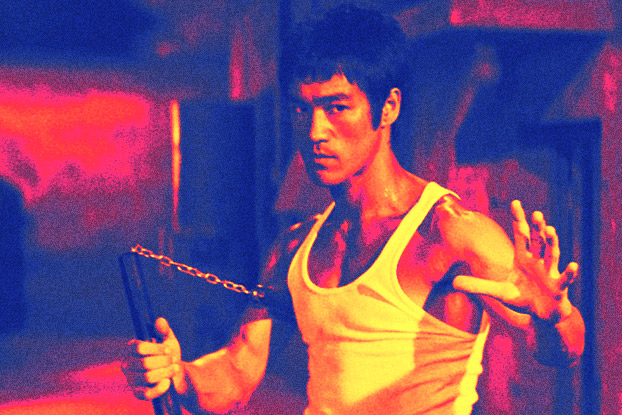
Bruce Lee helped popularize this approach.
Before MMA was officially established, Lee “visit several hometowns,” so to speak, and learned multiple disciplines from multiple teachers.
He didn’t marry one system. Instead, he adopted a hybrid approach (Jeet Kune Do) that combined elements from multiple fighting styles.
It was based entirely on pragmatism – what works – rather than tradition.
One way he described it:
"Absorb what is useful,
discard what is not,
add what is uniquely your own."
And what can this tell us about modern spirituality, exactly?
The parallel is probably clear.
“Traditional” spirituality is based on the Hometown model.
For a person born into a particular culture – Presbyterian, Baptist, Buddhist, Taoist, atheistic, etc. – that approach forms the basis of someone’s heritage, character, and identity. With the Hometown model, a person is born and dies within a single, particular tradition.
That is how things worked for a long time.
But times have changed.
Today, the ideas of every religion, culture, and spirituality are almost at our fingertips.
Staying purely within one’s hometown has become much trickier.
It’s become much easier to “travel,” in more ways than one. The world has shrunk. We’ve overcome time and space in ways that have changed the game dramatically.
This state of affairs has brought the Mission model to spirituality.
The “Mission” model isn’t centered on a particular tradition.
It’s centered on a mission or goal.
The “goal” itself might vary.
It might be described as “salvation,” “enlightenment,” becoming a saint or sage, reaching or achieving something like “satori,” “nirvana,” “union with God,” “heaven” or “Paradise,” a “second birth,” “atonement,” being “filled with the Holy Spirit,” “Self-Realization,” etc.
The goal itself might change.
But they all share the goal-centered dynamic in common. It's often an individual change in orientation.
Whatever helps someone reach that goal is adopted.
Whatever hinders someone from reaching that goal is dropped.
The Hometown model is identity-centered.
The Mission model is goal-centered.
Many people today are changing from the Hometown model to the Mission model.
And what would someone practicing Mixed Spiritual Arts look like?
It might look something like this:
A person experiments with a form of Buddhist meditation, finds it beneficial, and adopts it as a regular practice. That individual might also study yoga for fitness/health reasons and the mind/body integration. The person might also study Taoism for the insight into subtle energies and the integration of physical vitality. That individual might also attend church services and serve as a member of a community that works with orphans or the homeless. That person might also study both eastern and western philosophy and try to weave them into a single, coherent tapestry.
Sometimes, a person working along these lines can thrive.
And sometimes, things along these lines can also go off the rails.
For some, the situation described above might seem strange, messy, and confusing.
It might also seem like a lot of work.
It also might look like a person is toying with an array of incompatible ideas and lifestyles, like puzzle pieces from different puzzles.
Call it “syncretism.”
What worked for Bruce Lee won’t necessarily work for everyone.
For others, it might fit like a glove.
Many would agree that some aspects of karate, jiu-jitsu, judo, and others are incompatible.
Some might teach aggressive attacks, for example, while others emphasize more reactive defenses.
And how would such apparent contradictions get ironed out?
For those taking the Mission approach, they get solved in the ring.
That is, they get sorted out solely by what makes someone more or less effective as a “fighter.”
The ring is the great leveler and testing ground.
And to be fair, to anyone looking closely enough, essentially every system of thought contains contradictory elements.
In Buddhism, the Mahayana, Theravada, and Vajrayana branches have disagreed on major topics for centuries. Christianity experienced both the Great Schism and the Protestant Reformation, which led to several major branches and thousands of denominations. The same dynamic has occurred in Islam, Hinduism, Taoism, and others. And there are denominations within denominations.
It's often curious to see that those who share denominations often become each other’s fiercest critics. The worst enemies of certain Plato scholars, for example, are often other Plato scholars. Mathematicians fight with other mathematicians.
For many people today, this is now the way things are.
For them, this kind of messy, experimental, try-it-and-see, DIY Spirituality is what life today is actually like.
Some despise it. Others relish it.
Whatever our personal feelings on the matter might be, we’re better off with a clear view of the broader scene.
It can be like the Wild West out there.
It can also resemble the early days of science.
There were once many different models and ideas for how electricity might work.
Eventually, of course, we figured it out. “How electricity works” is no longer the vast mystery it once was.
And MMA training is now much more efficient than it once was.
Instead of studying multiple disciplines separately over decades, individuals can learn the most effective fighting techniques from multiple approaches in highly distilled training sessions and in short time periods.
What once took years can now be done in weeks and months.
This points us toward a key question.
Could the same progress happen in spirituality?
Granted, spirituality is infinitely more complex.
But it seems like something worth looking into. These topics aren't exactly things we can avoid, even if we want to.
In the meantime, it looks like things are going to stay messy for a while.
With that in mind, it’s worth exploring a few routes to navigate through this terrain.
Hometown and Mission models both have advantages and disadvantages.
The Hometown model offers stability, identity, tradition, and community. It’s worth clarifying: just because something is “Hometown” doesn’t mean it’s wrong. The cliché that “an expert is someone from out of town” while “a prophet has no honor in his hometown” points toward a preference for the merely unfamiliar or exotic and “grass is greener” bias. But more to the point, by its nature and structure, the Hometown model can serve as an antidote to uncertainty, loneliness, and lack of identity. If someone participates in a particular tradition, they automatically inherit structure and tradition as well as a community of people who share common values and “speak the same language.” It offers someone roots, an anchor, and a sense of home.
On the other side, it can also restrict and limit. Some Hometown models aren’t anything near comprehensive or complete, and even those that work well aren’t always the right fit for specific individuals. They can get stuck in the past, and grow stale. They can also lose the spirit that birthed them and become bureaucratic, closed, stifling, and filled with mere opportunists. The advantage of structure can turn into a disadvantage when it becomes limiting. A tradition that forbids dancing (obligatory Footloose reference) might miss out on some good moves.
The Mission model has its advantages. It can be highly effective. It’s open to innovation and evolution. It can be wide-ranging and exploratory. In a street fight, someone who has studied karate, judo, jiu-jitsu, kickboxing, and aikido – all other factors being equal – will probably have an advantage over someone who has studied only karate. Since there’s no allegiance to one particular camp (or hometown) over another, there’s freedom to innovate, experiment, and evolve, which opens the door to greater creativity and fresh potentials.
But the Mission model also faces serious challenges. Again, it can be like trying to put a puzzle together with pieces from multiple puzzles. Navigating the terrain of contradictions can be difficult and confusing. Someone taking lessons in karate, judo, jiu-jitsu, and so on, all at once, might have a hard time deciding whether to punch, kick, grapple, spin, or run. Amid incompatibilities of ideas and obscurity in language, individuals might suffer from more than a few cases of philosophical indigestion. “Don’t mix your drinks” is advice some offer. The lack of formal structure also means that individuals typically “go it alone.” There’s rarely community or companionship where people speak the same language, hold common values, or share a common history. Even trying to build community along these lines (a contradiction in terms in some ways – a “community of nonconformists”) can be like herding cats. Mission model types, for better or worse, tend to be solitary creatures.
This is also explored in Hazards of Going Spiritual But Not Religious and In Defense of Going Spiritual But Not Religious.
In these ways and others, our current situation can be both a blessing and a curse, full of both opportunities and hazards.
The optimal route for – for some, at least – might be less of an either/or and more of a both/and.
But even then, the choices can be difficult and the outcomes uncertain.
The modern spiritual world is largely uncharted territory.
A few cartographers have done great work at mapping things out. Ken Wilber, for example, is likely the most popular thinker who has worked to solve these problems. But the challenges, complexities, and personal nature of this situation remain daunting for many.
In the end, it’s still hazardous terrain.
We have nearly unlimited information, but a limited ability to process that information.
We have the entirety of the world’s philosophical and spiritual traditions within reach, but this seeming benefit can lead to increased conflict and tension when those efforts are incompatible.
We have more ways to communicate instantly with almost anyone across the world, but this can lead to greater disagreements and arguments when there’s no genuine dialogue.
Without “Know Thyself,” things can get messy real fast.
Cross-training of the soul can lead to existential fitness.
It can also lead to playing around with forces we don’t entirely understand.
The modern spiritual scene offers incredible opportunities.
But mere “opportunity” can be a double-edged sword.
For example, imagine someone suddenly and unexpectedly inherits millions of dollars.
Most likely, that person would be thrilled - at first.
But imagine that individual was a 14 year-old boy with hands-off parents. That situation could easily disintegrate into a tsunami of candy, video games, parties, school dropouts, guns, drugs, addiction, violence, and Lord of the Flies.
It isn’t necessarily a recipe for genuine, long-term happiness.
But once again, Bruce offers some decent advice.
“Do not pray for an easy life,
pray for the strength to endure a difficult one.”
We’re all punching, kicking, and grappling our way through the Mixed Spiritual Arts arena these days.
It can be a bruising experience.
But if we play it right, it can make us stronger and clearer.
And hopefully, when it comes to the Great Bout we’ve signed on for in this existential cage match of life, we can find ourselves closer to whatever that final belt, title, or trophy might be.