
HOW TO GET PHILOSOPHICALLY FIT, PART II
Article by LiveReal Agents Grace, Mary, Blake, and Thomas
There’s a unity to philosophy.
“Until Rousseau, the philosophical world had a certain unity.
This has disappeared for the time being,
but perhaps not for long.”
- Bertrand Russell
Imagine building a car from scratch.
First, we build a set of brakes.
Then we try to take the car out for a spin. Obviously, we don’t get very far.
We then add a steering wheel and try again.
That seems slightly better. But still, hardly a road trip.
Then we add a carburetor, an exhaust pipe, and an air conditioner.
It’s a motley, random, disjointed assortment of pieces. They don’t work together, they’re missing some key ingredients, and there doesn’t seem to be any top-level strategic plan to make it all work.
That’s how many of us build our life philosophy.
It isn’t our fault. No one (likely) taught us how to do this effectively. Our teachers most likely never learned themselves.
That leaves us all to just muddle through the best we can on our own, making it up as we go along.
The result often winds up with a kind of patchwork assembled from various disconnected elements. For many machines (cars, airplanes, computers, etc) none of the pieces really will work until all the separate pieces start working together.
Philosophy works the same way.
Philosophy, in some ways, is an “Everything Problem” that requires an “Everything Solution.”
We often approach the problems of philosophy one problem at a time.
“What is the meaning of life?” we might ask, and wonder it as if we’re asking about the sand on the moons of Jupiter.
We might ask “What’s the nature of the universe?” or “How do we know anything at all?” or “Why do people do what they do?” and read various experts who specialize in each topic.
But sometimes, asking one question at a time is a mistake.
Approaching the core problems of life one small piece at a time is like building a car one piece at a time.
A car won’t move a single inch until late in the game, after a lot of work has been completed, and the various pieces – the engine, chassis, wheels, etc. – all work together.
Wrestling a bear one claw at a time only gets you mangled.
The solution, then, is to wrestle the whole bear, all at once.
The “whole bear” of philosophy is made up of five basic questions.
1) What is real?
2) How do I know?
3) Who or what am I?
4) What’s the point?
5) What should I do?
These correspond to the major categories in traditional philosophy.
1) Metaphysics (“What is real?”)
2) Epistemology (“How do I know?”)
3) Psychology (“Who or what am I?”) (This could also be termed “human nature” or “philosophical anthropology” for whoever wants to play that game.)
4) Teleology (“What’s the point?”)
5) Ethics (“What should I do?)
Getting clarity in these five categories is incredibly helpful.
The five categories can encompass practically all major elements of a life philosophy.
Becoming skilled and practiced at placing the totality of your life experience into one of these five categories can be illuminating.
These broad categories can help visualize the overall landscape much like a map of the earth is broadly organized into continents.
A martial artist is skilled in just a few specific categories, such as striking, blocking, grappling, defensive skills, footwork, and weapons.
Similarly, a philosopher has skills in these five categories.
To “be philosophically fit” is to know your metaphysics, epistemology, psychology, teleology, and ethics.
To be less-than-philosophically fit is not to know your metaphysics, epistemology, psychology, teleology, and ethics.
The aim, then, is to achieve clarity regarding those questions and answers in a way that’s conscious and systematic.
There are two keys to make sense of this.
The “bear claw” metaphor points to the unity of philosophy.
In a healthy and accurate philosophy, the various pieces aren’t scattered around in disjointed piles. They’re unified. The various ingredients aren’t like the barely-assembled car. The elements aren’t islands, living on separate continents that are separated by vast oceans. They’re like the individual components of a car – the wheels, the engine, the axles, etc. that work together as a unified whole.
With this in mind, individual pieces affect the others. The answers to metaphysics affect the answers to epistemology, which in turn affect the answers to ethics.
They’re interconnected.
The first key is hierarchy. The second key is the chains of causation.
Certain pieces govern others.
Since various elements are interconnected, certain answers determine other answers.
There’s a hierarchy.
Some consider “hierarchy” to be a dirty, taboo word that inevitably involves some form of “oppression.” That approach is mistaken. Not all hierarchy inevitably involves oppression.” Certain forms of hierarchy are natural, unavoidable in the universe, and self-evident.
Take a finger. A finger contains a kind of natural hierarchy. What is the position of a single finger? Well, that’s determined in part by the position of the hand. What determines the position of a single hand? Well, the hand is determined in part by the angle of the wrist. And so on. The angle of the wrist is decided in part by the angle of the elbow. The elbow in part is determined by the position of the shoulder. The shoulder in part is determined by the position of the waist. The position of the waist is determined in part by where a person is standing. There is a hierarchy, from feet to finger and everything in between. The pieces are connected, and the location of the feet has a huge effect on the location of the finger.
The elbow doesn’t “oppress” the hand. Rather, the above creates a certain order in the process.
Here is where a lot of folks take a wrong turn.
When they encounter some Big Questions or existential riddles, they approach them one at a time, separately. They might ask, “What’s the meaning of life?” as if “meaning” is something that exists separately from everything else. Or they ask, “How do I know?” as if the act of knowing is separate from everything else. And so on.
They also get things out of order.
They might focus on building brakes before they even have wheels, or on the air conditioner before they even have an engine or battery. They focus on details while ignoring the bigger, foundational pieces. They ignore the interconnections and hierarchy, which means they upset the natural flow, and inevitably wind up in a fog of confusion.
Again, this experience of the process is completely understandable and sometimes even unavoidable, given the disarray of our mainstream culture.
But trying to solve certain problems in isolation won’t work.
“We cannot solve our problems with the same thinking we used to create them” is a quote allegedly from Einstein.
This applies to philosophy in droves.
For example, ethical problems can’t ultimately be solved on the level of ethics.
If someone asks, “How should we live?” – that question can’t be answered simply by examining various ethical approaches.
Teleological questions can’t be solved on the level of teleology.
If someone asks, “What’s the point?” – that question can’t be answered merely by examining various answers to the meaning of life. (The result of that typically leads to, “Well, maybe this is the point, and maybe that’s the point. Who knows?”)
Epistemology questions can’t be solved solely on the level of epistemology. If someone asks “How do we know?” they’ll eventually have to reach beyond epistemology for answers.
These efforts often run aground because they ignore the unity of philosophy and the two keys of hierarchy and causation.
It’s easy to see this in political debates.
Imagine a scenario where two talking heads argue on television about a specific topic. Predictably, they each make their speeches, trying their best to trip each other up, and conclude that the other is sorely mistaken. The discussion, as usual, generally goes nowhere. Why?
These two people are often on completely different sides on matters of metaphysics, epistemology, psychology, and teleology.
But they want to argue solely about ethics.
They often want to argue about how someone should act in a highly specific scenario while using completely different models for what human beings should aim for, what a human being is, what anything is, and how we can possibly know any of it. Winding up with a lack of resolution under these conditions is inevitable.
But with the tools mentioned above, things become much clearer.
If our goal is to build a sound life philosophy, walking this tightrope becomes much easier.
First, we get the order correct.
Then we take the interdependencies into account, which allows us to approach the problems in the proper order.
Here is the “proper order.”
Metaphysics comes first.
After that, it’s epistemology and psychology.
Then, it’s teleology, and finally, ethics.
In some ways, they’re all unified and interdependent, and should be approached as a whole. But in other ways, we can only consciously process things one at a time, which is something we need to account for. Approaching them in the proper order is the way we account for it.
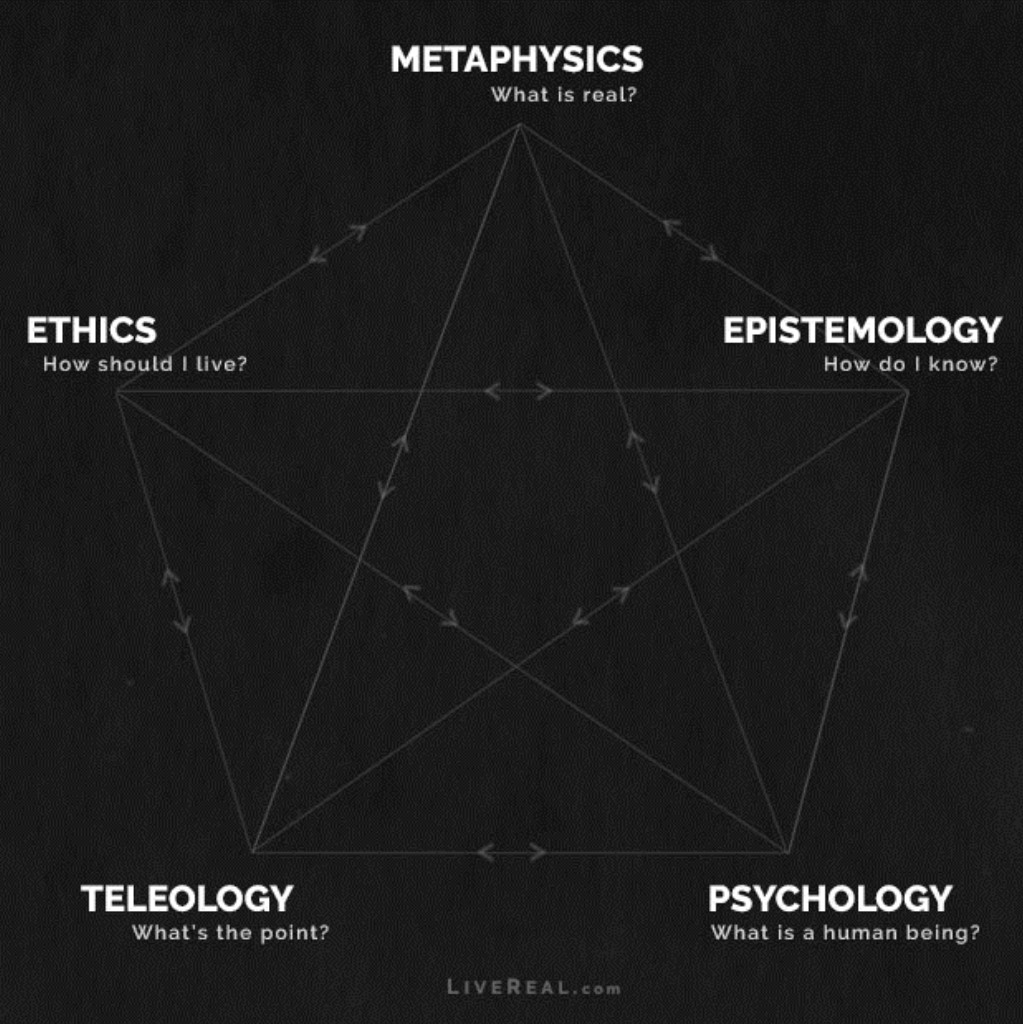
There’s the view “from the top down.”
According to this view, there’s “what is” (metaphysics), then there’s “what we know” about what is (epistemology), then there’s “what we are” (as one of those things that is – aka, psychology, or “human beings”), then there’s “what we humans are built for” (teleology), after which comes “what we should do.”
We don’t expect a dog to meow or a cat to bark. What a dog does (bark) follows from what a dog is (its “nature”), which follows from what anything is (metaphysics).
The reverse of this, or the view from the bottom up: “what we do” (ethics) depends on what we’re aiming for (teleology); what we aim for depends on what we are (psychology); how we know about ourselves (epistemology) depends on how we know anything; how we know anything depends on what is (metaphysics).
Again, the overall system is holistic. In practice, the relatively clean process outlined above doesn’t necessarily always march in a straight line as a single, linear process that unfolds from one discrete and orderly phase to the next. It’s ultimately a web, where everything is connected to everything else. Still, as a general rule of thumb, this order still applies and illuminates key aspects of the process.
We could map these interdependencies in detail.
There are ways psychology affects metaphysics, epistemology affects ethics, ethics affect epistemology, psychology affects teleology, and so on.
But exploring the intricacies of this comprehensively could be a book-length endeavor, which isn’t the aim here. This process entails working out the broad answer in greater detail or out to additional decimal points.
Once the basic insight is in place, the rest of the dominoes tend to fall naturally. The entire process picks up momentum and begins revealing itself. Once the natural interconnections become visible, they become hard to miss.
One brief turn here, however, can help.
The biggest point of contention probably lies with the discussion over the question: “What comes first? – metaphysics or epistemology?”
A thought experiment is helpful at this point.
Imagine a starting point being a metaphysical statement that “Reality is ultimately a creation of God.”
The immediate response often switches gears.
It asks, “How do we know? How do we know there is a God?” (This switches over to epistemology.)
It works the same way even with a different metaphysical claim. For example, the claim could be this:
“’Reality’ is ultimately senseless, meaningless, unintelligent matter that arose by accident and is governed by natural laws.”
The above is a metaphysical claim, and it could also be followed by the same response, and switch to epistemology:
“How do we know that?”
This seems to result in a standoff.
Which needs to come first? Metaphysics, or epistemology? Epistemology, or metaphysics?
It can seem at first like a “which comes first – chicken, or egg?” problem.
In the above case, the implication is that before declaring any metaphysical positions, we must initially be certain. We must first solve the problem of genuine knowledge (or acquire genuine knowledge about genuine knowledge), and then and only then can we move on to exploring the nature of the universe, or metaphysics. In other words, “We don’t know what is real (metaphysics) until we know knowing itself.”
But that approach assumes that epistemology must come before metaphysics. This leads to dead ends.
It creates a tailspin.
We can ask “How do we know?” “And how do we know that?” “And how do we know that?” – endlessly. “To acquire genuine knowledge, we need genuine knowledge about the process of acquiring genuine knowledge, which means we need knowledge about knowledge about knowledge…” and so on. It becomes an infinite whirlpool of questions that never arrives at an answer, because – like the Hydra – every answer generates more questions. It creates an endless paralysis of uncertainty fueled by a relentless habit of toxic doubt. (The strategy of infinite doubt is one thing worth doubting.)
Yet some problems seem logically intractable that can be solved practically.
When we move beyond the head-game space of pure thought-playing-with-logic into the real world, we understand that we’re able to just try things out, to adopt positions on a trial basis, and see how they work.
This allows us to see where and how the logical consequences play out.
This approach solves the chicken-egg dilemma by recognizing the interdependencies within each approach and abandoning the “single sole point as the single sole starting place” position. It cuts the Gordian knot.
How?
By changing tactics. It switches gears from an exclusively straight-line approach – Step A, Step B, Step C – to a systems-based approach, where multiple interdependent processes happen at once.
It wrestles the whole bear instead of the single claw.
We can run an experiment where we settle on metaphysics first.
For example, we could adopt a premise that “There is an infinitely intelligent God that created the universe, and created us as creatures with the capacity for genuine knowledge.”
With that as a starting point, and with everything that naturally follows, the path forward is clear. (The position in this example is from a worldview of theism.) Knowledge is possible, human psychology is capable of acquiring knowledge, and beyond that point, the rest clicks together.
After establishing a position on metaphysics, the rest is largely a matter of hammering out less significant details.
The risk of slipping on ice endlessly and never getting traction dissolves.
To be clear, this doesn’t point toward a “blind leap” into an arbitrary metaphysical position. It’s more about illustrating the process of overcoming gridlock.
The same process works even if our metaphysics arrives at a different position and reaches different conclusions.
For example, we could look to an experiment where we land on a metaphysical position where “The universe is a vast cosmic accident, composed solely of material objects operating on the basis of blind forces, guided by nothing and ultimately leading nowhere.”
Even this still helps us.
How?
With this metaphysics in place, our philosophical quest – while potentially angst-ridden – becomes manageable.
If we're consistent in this position, it allows us to bypass what would be – as determined from the start – a fruitless search to understand the nature of knowledge, or the universe itself, because – according to our metaphysics – human knowledge is basically impossible. There might be an illusion of knowledge (since our brains would be defined as accidents of nature), but ultimately, we’ll never find it, which means we don’t need to suffer or berate one another for not having it.
(The position outlined here is an aspect of some forms of agnosticism, nihilism, or materialism.)
But this may not seem fair.
Isn’t just landing on some metaphysical question a “blind leap of faith” that’s ultimately arbitrary? Isn’t it cheating?
It isn’t cheating because it’s systematic in a way that’s akin to the scientific method. It tentatively adopts, on a trial basis, a metaphysical claim, and then follows the trail of clues wherever the natural logic of that claim takes us. In this sense, it’s genuinely more like a scientific experiment or thought experiment with built-in reality checks, presentations of evidence, public statements that are open to discussion, and so on than an arbitrary dart-throw at a wall.
In this, we use every tool at our disposal – logic, reason, empirical evidence, intuition, imagination – and crunch all data as much as possible, which offers a battering ram capable of breaking the intellectual gridlock.
It’s possible to take a deeper dive here – which we won’t take.
Those who enjoy this sort of thing can consult Methodological Realism by Etienne Gilson and After Virtue by Alisdair McIntyre.
For the rest of us, the matter can be simplified greatly as boiled down to a very basic choice summarized by McIntyre.
The choice is between Aristotle and Nietzsche.
Most fundamentally, the choice boils down to this.
In the deepest heart of the universe, is there intelligence, or chaos?
Our answer to this question largely determines the most fundamental direction of our metaphysics, which determines the rest of our entire worldview.
In a nutshell, Aristotle represents “Team Intelligence,” or the metaphysics that knowledge exists, or that on some level, there is some sort of higher Reality – in a word, “Logos” or “God."
Nietzsche represents “Team Chaos,” or the metaphysics that our ultimate backdrop of the universe is nihilism, or blind nothingness-chaos-emptiness (however heroically we might struggle to overcome it).
Our choice here determines our basic metaphysics.
That choice governs a significant part of our epistemology.
If we’re on Team Intelligence (with Aristotle as head coach), we can rest assured that knowledge is possible because we are created beings with a capacity to know reality.
We can argue about finer points beyond this initial ground (as many specialists do, endlessly) – but the basic foundation is now in place.
If we’re on Team Chaos, then genuine knowledge is impossible, except possibly for a few rough glimpses at the fringes of things – and the rest, as Succession’s creator Jesse Armstrong might say, is a fight in the mud for a knife.
And with that, the rest can follow naturally.
For Team Chaos, teleology, psychology, and ethics also fall into place.
Teleology: there is no grand, cosmic, objectively real purpose in the universe, or to human existence, or to the individual lives of human beings.
Psychology: human beings are either 1) evolved animals with overgrown brains, 2) machines with an accidental side-effect we call “consciousness,” or 3) cosmic accidents.
Ethics: given our nature, we can either 1) dedicate ourselves to satisfying our animal drives and creature comforts as much as possible, 2) try to engineer our machine-selves as effectively as we can, based on our programmed desires, or 3) just do…whatever, because nothing matters anyway.
For Team Intelligence, the options are very different.
Teleology: there is a grand, cosmic, objectively real purpose to the universe, human existence, and (at least potentially) in the personal lives of individual human beings.
Psychology: human beings are created creatures with “reason” or a “soul” or a nous or some sort of spiritual component which can either be developed (which leads to flourishing) or ignored (which leads to inner deterioration).
Ethics: given our nature (and how the universe is made), we have a core foundation to orient our individual lives around. We should aim to develop our reason, soul, or nous to the highest capacity possible, which includes strengthening and clarifying our intelligence, orienting ourselves around sanctification, aiming to become a saint or sage, striving to achieve spiritual awakening, theosis, moksha, “enlightenment,” or something along these lines, which also involves treating other humans well.
Clearly, the two broad choices aren’t exhaustive, and still leave a great deal to figure out. (No map is as detailed as the territory.) But it highlights an early fork in the path that will decide much of what comes after, and in that sense, can help simplify what otherwise could be a hopelessly complex situation.
These illustrate the key point.
The key point is that the various questions are interconnected, and the answers to one determine the answers to others.
Knowing this creates a profound advantage when compared to trying to attack the questions separately.
It also simplifies the process of attacking huge, seemingly unanswerable questions that seem utterly beyond our capacity to answer.
It helps because the answers fall into a finite number of groups.
We can call them “worldviews.”
There’s a kind of chemistry at work here.
Certain ideas attract and are compatible with others in the same way certain atoms, chemicals, and individuals are compatible with others. Along these lines, Big Answers tend to cluster into a limited number of recognizable categories.
Call it a “worldview,“ a “life philosophy,” a “paradigm,” a “core belief system,” a “vision,” or any number of labels, etc.
They all point to the same thing.
The various worldviews are introduced here.
A step-by-step process of arriving at them is explored in book form here, in an online article here, and with an online tool here.
These become the “operating system of the mind.”
The operating system on a computer is the foundation of software/hardware that usually operates in the background, except when it causes crashes or needs an upgrade. (“Crashing,” in this instance, is what creates an existential crisis in human beings. And we experience the “need for an upgrade” as “angst.”)
We have some power in choosing our worldview.
The process of “choosing” a worldview can be smooth and natural – for example, when we’re raised with a healthy and functional belief system that is fully compatible with both our conscience and the world.
But the process can also be a bit bumpier.
A major upgrade of an operating system can sometimes mean pausing the day-to-day functions for at least a few minutes in order to change some fundamental elements around.
The task might, in some cases, seem overwhelming.
Does someone really “choose” a belief system? If so, how?
In reality, this is an organic process, played out within the messiness of everyday life.
We aren’t purely logic-driven Spock-like data storage bins; we’re gasping, grasping, flesh-and-blood creatures.
Within this realm, certain ideas aren’t merely logical or illogical. They also make sense and feel right – or not. Certain experiences resonate with us, and others don’t. We can intuit that something is off (or on) even if we can’t verbally articulate it. Even professional philosophers find certain extensively developed arguments “persuasive” while others don’t. Psychology often precedes philosophy. Belief systems, worldviews, and life philosophies follow in the wake of all of this, which makes conscious, logical choice often seem to play a rare, or at least limited, role.
But again, the approach doesn’t have to be overly complicated.
Choosing the initial fork in the path determines whether we’re generally on Team Intelligence or Team Chaos. That initial choice is based not merely on pure logic, but on intuitions, feelings, life experience, and the kind of creature-stuff mentioned above. Beyond that point, the various worldviews range on a broad spectrum.
In one direction, with Team Aristotle, is theism. (Brief note: that Aristotle himself was technically a polytheist isn’t relevant. In this context, Aristotle is being used more as a mascot than as a literal role model.)
On the further side of Team Nietzsche is nihilism.
In between are deism, pantheism, materialism, agnosticism, existentialism, and nihilism.
These are explored in greater depth here.
We can briefly clarify the differences between these worldviews.
Theism here views the universe as created by an infinitely Intelligent Creator (“God,” the Godhead, the Absolute, etc) that/who is both immanent (within the world) and transcendent (beyond the known world).
Deism is similar to theism, minus the “immanent.” It holds that the universe was also created by an infinitely Intelligent Creator, but that Creator is only transcendent, not immanent – and so, is “far away” or distant, and possibly even uncaring and impersonal.
Pantheism is similar to theism, minus the “transcendent.” Everything is Spirit, nothing isn’t Spirit, and Spirit is immanent – everything in the universe – but not transcendent, so “God” is everywhere and everything, but isn’t really beyond all space and time. Since everything is Spirit, there is no such thing as pure “matter.”
Materialism is the opposite of pantheism. According to this worldview, there is no Spirit, only matter. It’s atheistic. The world is composed of physical forces only, driven by natural laws. Intelligence might exist, but it likely just evolved largely by accident.
According to existentialism, we don’t necessarily know much about the universe – there’s a wide range of speculation on the matter – but in short, we know we’re here, wherever “here” is, and so we can only determine what to do for ourselves.
According to agnosticism, we just don’t know. (It’s a sort of existential penalty box, where epistemology looms large.)
According to nihilism, there is no Truth, God, knowledge, purpose, or meaning. The universe and human beings are accidents, governed only by blind chaos, and therefore, nothing matters and nobody knows anything.
(For a slightly different but more detailed exploration of options along these lines, see the book The Universe Next Door by James Sire.)
Those are the seven options.
When it comes to “wrestling the bear one claw at a time,” the options above are the “bears.”
The answers to the Big Questions cluster into worldviews, and each worldview contains a full set of answers (or, in the case of agnosticism, non-answers). In this sense, the above essentially covers the full spectrum.
To be clear, there are other, different ways to “map” these topics. Other approaches might categorize worldviews into just five categories, or twelve, or a different number. It’s possible to slice a pizza into three slices or fifty, and it’s the same with the universe.
But this doesn’t mean it’s infinitely elastic.
One parallel is how color works.
In printing, four colors of ink are used to create all others (CMYK, or cyan, magenta, yellow, and black).
With computers and digital media, on the other hand, there are three primary colors (RGB, or red, green, and blue) that can be combined to produce every other color that exists.
Which approach is “correct” – RGB or CMYK? Are there four primary colors, or three?
In practice, both approaches are useful. They can each apply in different contexts (one in print, the other in digital) depending on how they’re used. All to say, there’s flexibility when mapping, and different “languages” can be used to describe the same thing. The above can be developed as a kind of “Periodic Table for philosophy.”
But the first step is to create some order out of chaos.
Brushing with broad strokes is a necessary step in these matters.
This approach is more like a multiple-choice format.
It helps to know that the fundamental choices themselves aren’t an infinite sprawl.
This isn’t to say that there isn’t room for individuality and the ability to express uniqueness. But the choices – thankfully – aren’t endless. There’s either a God, or there isn’t. Humans can either achieve genuine knowledge, or they can’t. There’s either an objective purpose to human life, or there isn’t. People should objectively act in certain ways, or they shouldn’t.
This simplifies things immensely.
As Einstein said, “things should be made as simple as possible, but not simpler.”
In exploring these matters, there’s always a tightrope walk in between being too rigid or too loose.
This also allows plenty of room to mix and match. For example, someone might be part theist and part agnostic, or primarily materialist mixed with some aspects of existentialism, and so on. While some aspects of worldviews are incompatible, people embody those worldviews, and people can be complicated.
That said, practically every thinker will fit somewhere on this map.
Sartre and Hume, for example, could be classified as materialists. Nietzsche, Heidegger, and Camus could be classified as materialist-existentialists. Socrates seemed mostly agnostic, but also displayed strong qualities of theism. Plato, Aristotle, and Plotinus could arguably be classified as theists that leaned heavily deist. (Some regard them to be officially polytheists, yet they also believed in an ultimate “One,” unmoved mover, etc.) Aquinas, Descartes, Pascal, and others would be more straightforward theists. And so on.
Like categorizing movies into various genres of comedy, drama, horror, etc., some might combine genres or blur boundaries. Arguing about these can be part of the fun. But taking the genres themselves into account is a critical tool, and highly effective in quickly understanding various thinkers.
It’s always possible and good to explore these in more nuance and ever-increasing detail. But again, the aim at this point isn’t extensive detail. It’s to establish a foundation. Once the foundation is established, the nuance and detail can come later.
And then, at a certain point, there’s a decision to make.
Broadly speaking, what is your worldview?
Are you on Team Aristotle or Team Nietzsche?
Where do you land on the spectrum between theism (there is Intelligence and Order governing the universe) and nihilism (the universe is only pointless, meaningless chaos)?
It might not be a single clear “decision.”
It might be more like a realization. “I don’t necessarily decide that X is the case; I realize that X seems to make sense, while the alternatives don’t.” Again, in this sense, psychology often precedes philosophy.
With this answer in place, we now have a foundation.
It’s a platform where our Answers to the Big Questions are now in place, at least intellectually.
Beyond this point, the rest of the pieces often fall into place.
When metaphysics clicks into place, the others tend to follow.
The metaphysics of theism, for example, trickles down to epistemology. Theism entails an epistemology that includes empiricism (since the senses are reliable), rationalism (since logic is founded in a basic order in the universe), and revelation (since God can reveal knowledge to humans, humans can know at least some things about God). Since theology holds that there is a God (metaphysics), knowledge of the eternal and infinite is possible (either through a self-revealing God or through a Self-realizing human) – and philosophical realism is valid, so we can trust that we aren’t living in a vast illusion run by some cosmic mad scientist (ala Descartes).
Theism also entails teleology. Theism holds that human life is meaningful. Other beliefs and ideas are also compatible along these lines – for example, the ideas that death is not the end, justice will be served in time, perhaps in ways we don’t fully understand, what we do ultimately matters, and more. Our psychology or human nature reflects this as well. All of this also affects our ethics, or how we act, because theism means that the ways we treat one another have great significance.
This illustrates how metaphysics trickles down to the other categories in theism.
But this works in the other worldviews as well.
Deism, for example, maintains that a distant God essentially created the universe and then left it to run on its own, which is very different from a God that is actively involved.
Pantheism is roughly the opposite – “God” or Spirit is everywhere and in everything, but isn’t distant or transcendent.
Existentialism maintains that the universe might be benevolent, hostile, or indifferent – we might not know – but either way, it’s up to us.
Nihilism, again, declares that it’s all “sound and fury, signifying nothing,” which carries through the teleology, epistemology, and so on – while agnosticism insists that we simply don’t know.
Here’s an overly simplified summary of how these generally play out.
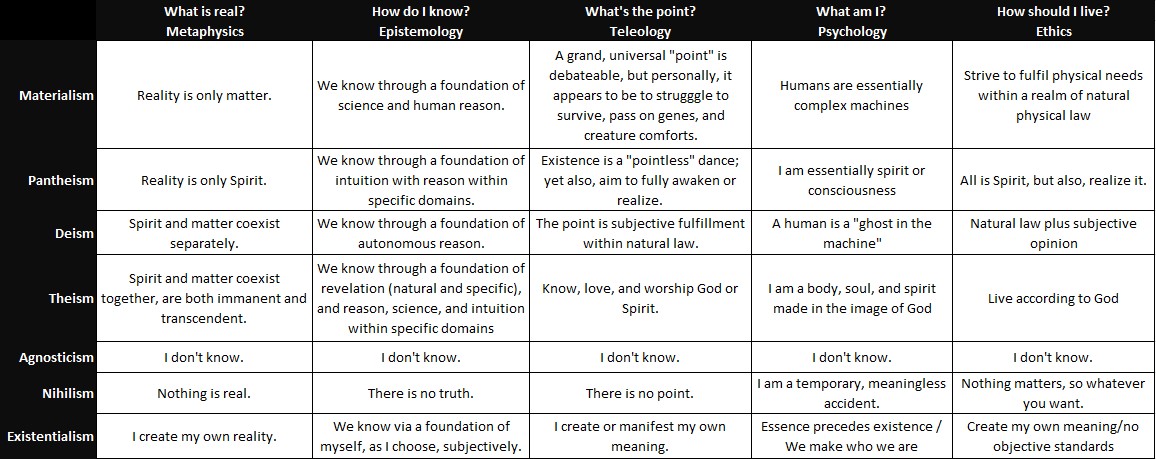
And with this, the Big Questions get answered.
With a worldview that has been consciously and systematically examined and locked in (while remaining open to revision and further development), the Big Questions find answers. In the above forms, they’re Answers on a broad, general, highly abbreviated intellectual front, but answers nonetheless. The challenge then becomes one of further applying, living out, testing, and refining that those answers consistently across all areas of life.
In an ideal form, this means your metaphysics, epistemology, teleology, psychology, and ethics work together harmoniously. Your answers to “What is real? How do I know? What’s the point? What am I? How should I live?” complement one another. Conflict and friction between the various individual elements transforms into a unified, cohesive whole.
Having these basic pieces in place means you are essentially “philosophically fit.”
It doesn’t end here.
Beyond this point, it’s a fresh beginning.
A worldview that intellectually answers the Big Questions on a basic level is a foundation. With a foundation consciously established and the structure on firm ground, the idea isn’t to stop building and wrap up, but to build more – to apply that worldview throughout the rest of life and see how it works.
We can run various tests to make that foundation even more sturdy, and to make the top floor reach even higher.
Good conversations – healthy, open, good-faith dialogue – is part of the “workout” routine that can help refine ideas and beliefs, getting us in better shape. They’re also a hallmark of sanity.
We can continue “thinking life through.”
We can encounter contradictions and work to resolve them with confidence.
We can find “bugs” in our mental source code and fix them. We can explore more advanced ideas and incorporate them.
If things are running efficiently, we will likely be less haunted by uncertainty – a lack of answers, or total skepticism of current answers – or by the confusion caused by hopping back and forth between various incompatible worldviews.
This “yardstick” helps us measure ideas.
It’s a framework that can help us make sense of experiences by allowing us to see their entire philosophical structure, from axiom to conclusion.
With a newfound ability to see various worldviews in action, the world can increasingly make more sense. Our philosophy, as the “lens we see through,” colors everything in view, for better or worse. When we develop our ability to detect our own and others’ allegiances to worldviews, we can better understand what makes us all tick through understanding the “colors” that filter others’ perceptions.
Exploring this can help us notice how the ongoing, churning collision of belief systems results from different core assumptions about the world.
Once we become able to see the “source code” of ideas in this way, the world no longer appears as noise in a chaotic and senseless battle.
Instead, it’s a conflict of ideas.
Clarity in this realm allows us to navigate life with a much clearer and more accurate map of the terrain.
While the content of our Answers to the Big Questions may develop and evolve over time, we now understand the process of acquiring, testing, and refining them.
At least to some degree, we are existentially and philosophically fit.
And we can move, with confidence, onward.