

So, what is LiveReal?
LiveReal is a headquarters for those looking for better answers to the Big Questions of life. (Call it "existential fitness.")
It's also the ongoing chronicles of a scrappy band of seekers on a quest to find the meaning of life or die trying.
More on all this here.
Below is a rough map of our findings so far.
Part I: The Problem | What's it all about?
We can start with the very basics.
"I want a great life.”
We might describe that in different ways. Call it "the good life," "the life well-lived," "the life with no regrets," etc.
But what is that?
What is "the good life"? How do you define it?
It can seem obvious. We all have some sense of an answer.
But the world is tricky. It's full of decoys, substitutes, counterfeits, and booby prizes. Does "the good life" mean it's one with wealth, fame, ease, status symbols, pleasant distractions - or is it something else entirely? Could you have all of those, but still miss something essential? Is there a "key ingredient"?
These questions depend on the answer to another question.
How is a life “measured”?
These are all Big Questions.
We all naturally ask these questions some level, consciously or unconsciously, even if it's only in some quiet moment in a deep, secret, hidden cavern in the back of our mind.
Big Questions are worth asking.

And if we're being honest: we're all asking them, already, at some level.
Life confronts us all with Existential Riddles.
We have no choice but to answer these "riddles," one way or another – if not consciously and verbally, then through our choices.
We're all playing some “Game of Life.”
But part of the trick is making make sure it's one worth playing, and then playing it well.
We could also say that “we’re all searching for something.”
But what are we searching for?
Call it "happiness," “sanity,” real “success,” “the higher life,” a “life without regret,” or just the search for "IT". (And what is “IT”?)
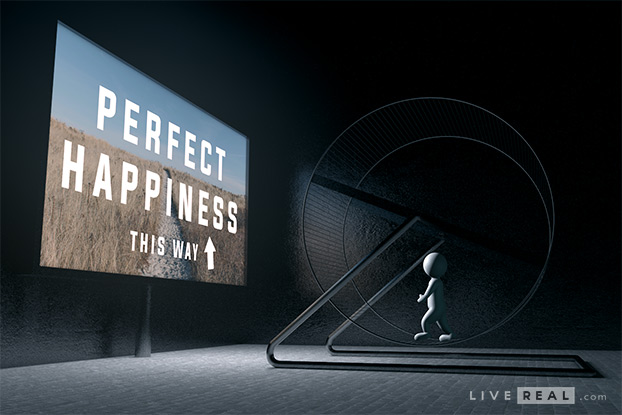
These basic questions serve as starting points - premises, assumptions, or axioms - to get things rolling.
They aim to be self-evident, commonsense, and practically universal.
And they all point toward some age-old, commonsense advice:
But how?
Part II: The Search for Answers
This business can quickly become complex.
It leads us into areas of self-help, personal development, philosophy, psychology, theology, mysticism, and beyond.
These days, there's no shortage of "answers." The problem lies in sorting through them all. This terrain is cluttered with advice, techniques, "experts," celebrities, and gurus-for-rent - all of whom often disagree. They often seem to be using different maps.
It can be a wild, chaotic, confusing scene.
How do we make sense of it all?
Each of us is on a sort of quest along these lines.
In this sense, we're all philosophers, theologians, and mystics. (That includes atheists and the “irreligious.”) The trick, then, isn’t whether we should do these things or not – we’re already doing them – but to do them well.
But again, how?
Part of the trick is to “think life through.”
We should start from a strong foundation.
We should probably get our "life philosophy" in shape.
A sturdy life philosophy is better than one that's fragile.
If everyone is a everyone is a philosopher on some level (meaning, everyone has a metaphysics, epistemology, teleology, and so on) then part of the trick is to get better at it.
It just means organizing our thinking. After all, our Big Answers tend to come in clusters. They're interconnected. (One answer determines another, which affects another, and so on.) Sorting this out involves clarifying our basic worldview (the operating system for everything we think, feel, and do, or “the lens we see everything through”).
That means our definition of "the good life" depends on our life philosophy or worldview.
After getting a strong foundation in place, it become a matter of defending it, ala “philosophical self-defense.”
But that can lead us right back to other Big Questions such as "Who am I?", and "Why am I here?"
Answering these means understanding “human nature.”
Part III: The "Human Nature" Thing
Call it “Psychology.”
The word “psychology” usually brings up a lot of issues: topics like anxiety (how to approach it, understand it, and deal with it), depression, “inner strength,” “existential crisis,” “self-esteem,” angst, psychological self-defense, how to avoid being manipulated, general happiness, overall sanity, and more.
We might be tempted to imagine that experts have already figured all of this out.
But there’s a lot that mainstream psychology admittedly doesn’t know (even if it rarely admits it). And even more: despite floods of self-help books, celebrity blogs, and Ten-Steps-to-Perfect-Effortless-and-Instant-Happiness lists, our general current state of psychological health isn’t great. (Neither is our physical health. This even goes for young folks.) Despite having advanced technology on the outside, we sometimes seem to be deteriorating on the inside.
Mainstream psychology today doesn’t seem at all close to reversing this state of affairs. In fact, it can sometimes even drive us crazier.

But why?
Part IV: Human Nature is Complicated
We could say that "psychology, in its current form, lacks a foundation."
In theory, psychology is a rigorous science. In practice, it’s often a sprawling, ever-expanding, disheveled pile of studies, data, and “disorders” without a comprehensive model of human nature to ground and unify it. With no framework for offering even a basic model of psychological health, a way to measure it, or even a rough sketch of the human condition as a whole, it becomes impossible to even understand the core question of why we do what we do (including why we do seemingly crazy things like join cults, climb Everest, or even see movies like Deadpool, Babylon, The Lighthouse, or Needful Things, for example).
But a fresh approach might open some doors here.
For example, we could work on preventing problems instead of just trying to solve them after they appear. We could hone in on the “sweet spots” in mental health, or beef up our philosophical game and get insight into things like angst, the existential crisis, or psychological self-defense (to complement our philosophical self-defense). We could approach psychology as dealing with “everything problems" instead of "component problems."
We could even get clarity on the strange advice to “be yourself” (which first means “knowing yourself”) - which also raises other questions about topics like the psychology of identity and what lies at the bottom of the “unconscious.”
But there's a twist.
Those exploring these frontiers of psychology soon find themselves standing on territory we’d have to call “spiritual."
Even the word "psychology" comes from psyche + logos or “science of the soul.”
The borders between psychology and spirituality have always been blurry, arguably, along with arguments over who has jurisdiction. (And it makes sense. To understand human beings also means understanding all of human experience, which includes religion and spirituality.)
This raises big questions about the human condition itself, including whether human nature contains some sort of spiritual component.
And so eventually, once again, we find ourselves back to facing the Big Questions.
In other words, when we dig even a few inches into human nature, we find ourselves surrounded by “spiritual matters.”
Part V: The "Spiritual" thing.
What's it all about? What's the point? What is real? Where do we come from? Where are we going? What's our origin and ultimate destiny? What should we do? How do we know? What the heck is going on?
Some folks are "spiritual." Some are "skeptics." Some are religious, others aren't.
Whatever our approach, these matters lie at the heart of everything.
Our most basic assumptions on these topics serve as the foundation for everything we think, feel, and do.
This means spirituality plays a huge role in our personal lives, whether we're religious or not.
But this also plays out on a larger scale. For example, we often hear that a “spiritual crisis” lies at the root of our “cultural crisis.”
If that's the case, then a “culture crisis” won’t be solved purely at the level of culture.
When we have radically different answers to the Big Questions – which means we don’t share a common worldview or life philosophy – then “cultural conflict” becomes inevitable. This can bring about a “Crisis of Foundations” on multiple fronts. Some could even say we’re now living through “The Death of God,” which Nietzsche tried to warn us about a while ago, or a “loss of myth” that’s now mutated into widespread “soft nihilism.” Left unchecked, it’s how civilizations collapse.
But this can also get personal.
We can go through a "death of God" or the same “crisis” or “collapse” on a personal level. This can leave good, intelligent, and sensitive people wandering through the “Existential No-Man’s Land,” which can then lead to an epidemic of angst and existential crises, and can generate a powerful sense of meaninglessness and existential depression. The entire saga can be fueled by “postmodern confusion,” bad assumptions, fragile worldviews, and losses of perspective that can easily be misdiagnosed as mere “depression” to be cured by pills (as if there are biological solutions to all spiritual problems).
Spiritual institutions are supposed to offer some relief here.
Yet often, they don't.
In fact, they can sometimes confuse, mislead, bore, dilute, or compound the problem.
That sort of failure can lead to a rise of “Nones” or “Spiritual But Not Religious.”
But going SBNR or “None” has its own hazards – like the risk of cults or substitute religions, for example.
This entire scene risks leaving us adrift and vulnerable when it comes to the Big Picture. That opens a door for mass marketing to swoop in and take over as the loudest, cleverest, or most attention-grabbing voice in the room. That could eventually lead to something resembling a life lived in a casino, where every flashing light and dinging bell is deliberately engineered to separate us from anything of value, and where manufactured pleasures are orchestrated to create artificial happiness and a simulation of relationships. The results can be demoralizing and dehumanizing. Life could then become a drab routine of drudgery and alienation where we're slowly being milked for resources until they’re all used up. It can seem very different from what we hoped would be "the good life."
It might all seem a bit bleak.
As D. T. Suzuki once said, "There are certainly things justifying pessimism."
But there are also things justifying optimism.
Part VI: The Work
The above describes a few potential hazards.
But it isn't the whole story.
In fact, the world being seriously messed up can lead a person to spirituality.
But that requires developing a specific kind of strength.
It means “getting in shape” - becoming “fit” not just in the body, but also in the mind, heart, and soul.
Call it “existential fitness.”

This kind of “fitness” means getting serious about the Big Questions.
It means actively searching for Big Answers, facing Existential Riddles, and working out a structurally sound life philosophy or worldview that’s sturdy enough to withstand whatever life might throw at it. It means honing the skills to become a better philosopher, theologian, and mystic, all of which can lead to an upgraded, higher level of answers to the whole “meaning of life” thing.
It doesn’t mean accessorizing with some casual armchair philosophy. It means adopting a no-nonsense spirituality – a near-necessity in today’s crazy modern spiritual scene (the "Wild West of the Soul") where the entire world’s spiritual traditions are practically at our fingertips. This perplexing situation can mean individuals changing from a “trust me” approach to one that’s “see for yourself” – one that isn’t based on blind faith, but embraces reason and science (not to mention common sense).
Amid all this, we seem to have a big opportunity to change things for the better.
If all goes well, it could even lead to a kind of Spiritual Renaissance.
What would that look like?
Part VII: Visions of Better Ways
There are many possibilities here.
On the personal side, a Spiritual Renaissance would mean a surge of physical, mental, emotional, and spiritual health.
For each of us, it can mean a stronger body, heart, mind, and soul.

But it's also more than that.
It also points to the transformation of the human being.
It can mean a personal quest that goes beyond the “merely personal” to “the beyond within.”
It reaches territories where there are no maps, where each of us must walk on our own.
But that doesn't mean we're alone. After all, we share much of this in common. We all long for some form of “spiritual awakening” and experiential spirituality that’s geared toward the transformation of the individual. Doing this effectively often involves a certain sort of “inner work” that can bring the best in "human potential" to fruition (and avoid the worst of all kinds). It can have the effect of “making the unconscious conscious” – as paradoxical as that might sound – and then wade into even more paradoxes, such as uncovering our deepest selves while also making us more selfless. Going beyond mechanical formulas or simplistic recipes, there’s often an organic process that kicks in when we adopt some form of contemplative practice and stick to it, or run some spiritual experiments and really grok the results, especially when it takes place within a greater context of a search for truth.

In short, it’s a way of life.
It’s a quest for “existential fitness” while seeking The Real in all things (in a world full of illusions and confusions), if that doesn’t sound too far out.
If you’re interested in any of these sorts of things, it probably means, at least on some level, you’re a seeker.
LiveReal is a kind of “headquarters for seekers.”
So, welcome to LiveReal.
You’re among friends here.
The above is a 10,000-foot flyover of some areas we’ve been exploring and continue to explore.
If you explore these things too, consider joining up or subscribing to our Newsletter.
Or, just poke around on the site (body, mind, heart, or soul arenas, for example), or check out Seekers, the comic (still in development).
Peace to the Wanderer.