
WHY CIVILIZATIONS (AND PEOPLE) RISE AND FALL
Article by LiveReal Agents Grace, Thomas, and Blake | Published May 25th, 2026
Civilizations rise, thrive for a while, decline, and fall.
It’s happened to Rome, Persia, Greece, Assyria, Spain, the Ottoman Empire, the British Empire, and plenty of others.
These rises and falls tend to follow a clear, consistent, and predictable pattern.
It’s a pattern that’s been explored and explained in some depth and detail (which we’ll dive into later).
It also raises an unsettling question.
We live in a civilization, right now. This civilization rose and has thrived for many years.
Will ours follow that same pattern?
Folks often respond to this question in one of two ways: positively or negatively.
In the first group, a civilizational “reset” might sound attractive to some.
The idea of “Civilization collapsing!” or the zombie apocalypse might seem exciting and dramatic – part Road Warrior, part first-person shooter game, part real life. Or, they might imagine it as a glorious return to nature, or like an across-the-board cure-all for certain painful problems.
That’s the fantasy version.
Of course, the reality would likely be profoundly different.
“Loss of civilization” actually means something more like entering a new “dark age.”
In reality, it would mean more poverty, tyranny, bad art, bad food, lowered overall intelligence, more illness and disease, crazier rulers, epidemics of stupidity and meanness – essentially, more overall misery on a widespread scale.
On the other side, some folks see that as an unattractive option.
But sometimes it’s so unattractive, in fact, that they’d rather just not think about it.
It’s understandable. It can be a deeply unsettling idea, after all.
But still: the pattern exists. History has tested it, time and again. And it’s naïve to assume that we’re immune to it.
What follows here is for those in neither of the two groups above.
But for those who understand instinctively that civilization is a good thing, and worth preserving, it’s worth asking: is this really something to genuinely worry about? Is it a looming threat? Where are we now in this rising-thriving-declining process, exactly?
Here’s a critical reference point some might find unsettling.
The average amount of time for most civilizations from rise to fall is roughly 250 years.
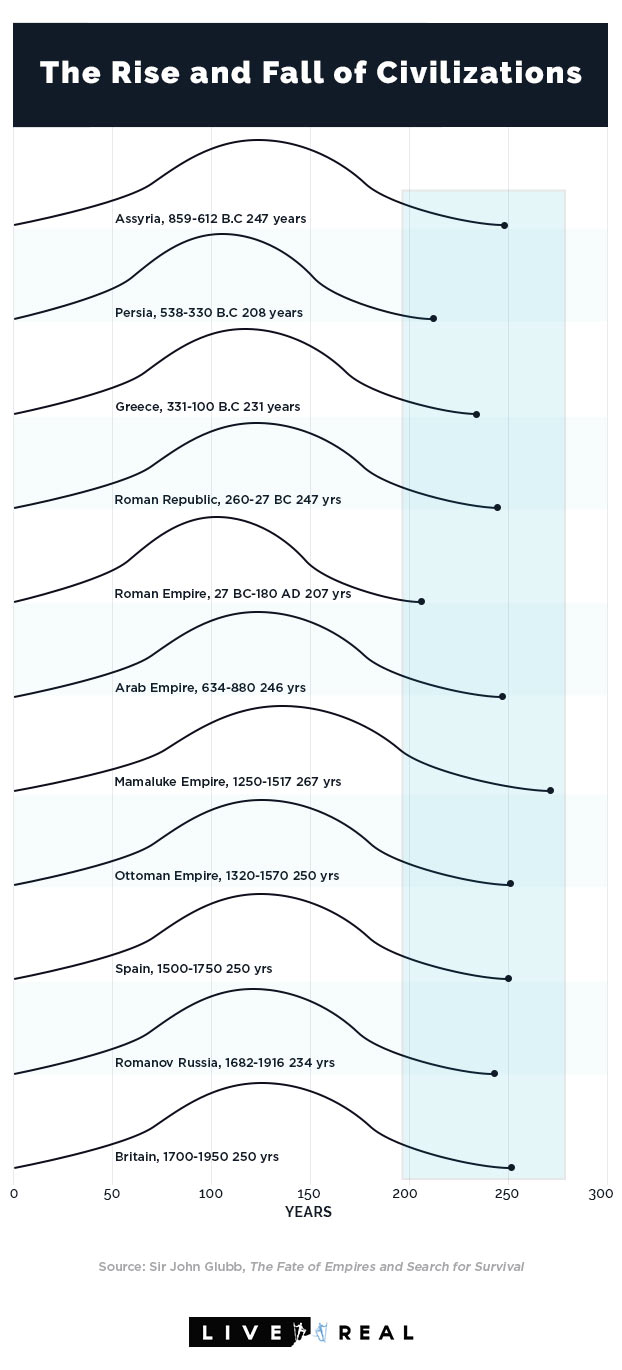
That insight originated in part from a researcher who studied the lifespans of Rome, Persia, Greece, Assyria, and others in great depth. (More on him later.)
This presents a challenge.
For those of us on the side of civilization who also aren’t in denial about the odds, it is a looming problem – and one worth wrestling with.
Sounds like a job for LiveReal.
One source of insight on this might be…rock ‘n roll.
Adopting rock ‘n roll as a gold mine of wisdom on this topic might seem like a wild detour.
But with sage guidance, we can dig deep, unearth this glittering nugget of insight, and put it to work in the service of the mighty challenge of cracking the riddle of civilizations’ rises and falls.
The “all-knowing sage” in this scenario is the venerable Dewey Cox from the movie Walk Hard.
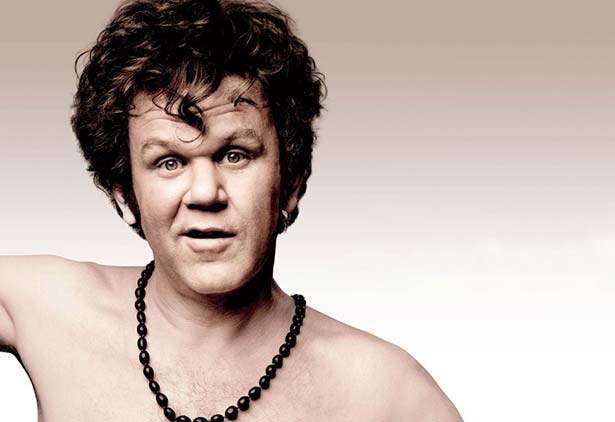
The parallel hinges on the “rock ‘n roll lifestyle.”
The key question is whether we humans can learn from our mistakes.
Can we learn from our mistakes?
The “rock ‘n roll lifestyle” – like the rise and fall of civilizations – also follows a typical, consistent, well-worn pattern.
It goes something like this:
Phase I: A talented young musician creates a few good songs.
Phase II: Those songs explode in popularity.
Phase III: That musician suddenly experiences wealth, fame, drugs, wild parties, sex, discovers things that promise to “take away all your bad feelings and replace them with good feelings,” and goes from “You don’t want no part of this!” to “I think I kinda want it!”
Phase IV: Adventures in self-destruction. (These might include pet monkeys, machete fights, and ripping a large quantity of sinks out of walls.)
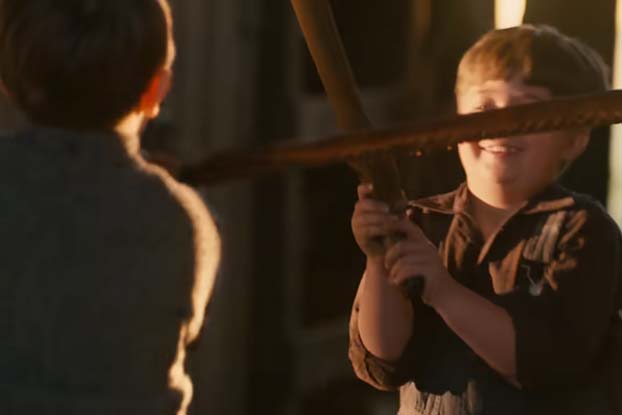
Phase V: After a great deal of destruction and bottom-hitting, there’s an awakening. “Gosh! I’ve been experiencing a great deal of unnecessary misery that is entirely self-created! I’ve been acting on the basis of some really bad ideas! I have not been thinking things through to their logical and inevitable conclusions! Since this path clearly isn’t working, I should probably try an alternate route!” – and so on. (The exact wording might vary.)
Phase VI: Blazing insights soon follow. (Example: “Quaaludes and waterskiing do not mix!” “Having machete fights is generally a bad idea!” Etc.) The rocker becomes older and wiser, and realizes that the rock & roll lifestyle actually isn’t the way to perfect happiness.
Phase VII: Musician adopts a new lifestyle that’s much more likely to lead to genuine, lasting happiness and peace, heals old wounds, and even experiences miracles (such as regaining the ability to smell, for example).
That’s the typical, well-worn pattern of the rock ‘n roll lifestyle.
This pattern gets repeated, over and over, time and time again.
Like the rises and falls of civilizations, it’s a story that keeps being retold, in sequel after predictable sequel.
“Young musician eventually ‘discovers’ that the rock & roll lifestyle actually isn’t the way to happiness.”
This “discovery” gets rediscovered, rediscovered, and rediscovered again, over and over, with every new generation.
Each musician probably feels as if they’re running some brand-new experiment. (They might “experiment” with drugs, for example, as if those experiments hadn’t already been run millions of times before, and as if the ‘results’ weren’t thoroughly predictable.)
But it’s so common, it’s a cliché.
It’s such a cliché that Walk Hard was created to make fun of it.
Dewey might seem like just a dim crooner who is not the sharpest bulb in the drawer. But like Socrates, Columbo, or Verbal from The Usual Suspects, his apparent ignorance might be deceptive.
After all, clearly, Dewey’s efforts were geared toward trying to point us toward an insight first articulated by the philosopher Hegel:
“We learn from history
that we do not
learn from history.”
And with this, we’ve encountered yet another disturbing idea.
It’s also a paradox.
Do we learn from history? No.
But then again, we have at least learned that. We’ve learned that we don’t learn from history. - which means, of course, that we do learn from history.
But what do we learn from history, exactly?
That we don’t learn from history.
Return to Step 1, repeat.
All of this raises a question.
Is humanity doomed to “learn” the same lessons, over and over again?
Are we stuck in a kind of Groundhog Day Universe? Are we stuck in some existential rut where we’re forced to keep repeating fourth grade?
Can a civilization rise that doesn’t fall?
We soon arrive at the idea of “progress.”
Western civilization loves the idea of ongoing improvement – the idea that things are going somewhere and continuously evolving. With developments in technology, we imagine that things are always moving forward, and “forward” to a better place.
By this logic, each generation would be smarter than the last.
But the rock ‘n roll lifestyle problem stands as a stark counter-example.
According to this, the evidence indicates that each individual has to learn the same old lessons, and learn the hard way – and so, there’s nothing new under the sun.
But is that really the case?
Does every new generation have to learn the hard way?
Does every rock ‘n roller have to learn the hard truth about the rock ‘n roll lifestyle firsthand?
Or, to get to the heart of the matter:
Is there a better way?
Is there a way to bypass the process of “learning the hard way”?
Can the pattern that has repeated itself throughout known history be interrupted?
Can we learn that machete fights are a bad idea without having to experience the full trauma of an actual machete fight personally?
Or, get to the heart of the matter: is there a way to escape the cycle of civilizational birth and death entirely?
If so, how?
Walk Hard breaks the pattern by making it conscious.
It makes fun of the cliches.
Once the pattern becomes fully conscious, it breaks the spell.
This changes the dynamic. Because we’re now aware of the experiences, we’re on guard. That allows us to watch for it and see it coming instead of mindlessly stumbling into it blindly. It arms us with the ability to break the pattern.
Carl Jung said it well.
“One does not become enlightened
by imagining figures of light,
but by making the darkness conscious.”
He also followed with this:
“The latter procedure, however,
is disagreeable
and therefore not popular.”
And this brings us back to our original problem.
Has anyone gone beyond the game-changing, Nobel Prize-worthy insight of Dewey Cox and worked to apply this to the problem of civilizations?
It appears so.
Luckily, one individual has studied this in some depth.
His name was Sir John Glubb.
He fought on the Western Front in WWI, was wounded three times and awarded the Military Cross, served under the Iraq Government, later commanded the Jordan Arab Legion, wrote over sixteen books, and much more. He was no mere academic.
He discovered the insight mentioned earlier – that the average lifespan for specific civilizations was typically 250 years.
But he also went much deeper. In his now-famous essay The Fate of Empires and Search for Survival, he also explained how civilizations, from their original rise to their eventual fall, all seem to follow a particular pattern.
The pattern goes something like this.
Stage 1) “The Age of Pioneers”
At the origin of a new civilization, there’s “the outburst” characterized by “an extraordinary display of energy and courage.” Small groups of individuals, often “poor, hardy, often half-starved and ill-clad…abound in courage, energy and initiative, overcome every obstacle” and launch what will become a great civilization.
Stage 2) “The Age of Conquests”
What follows the “outburst” is “a period of amazing initiative, and almost incredible enterprise, courage, and hardihood”…”early victories” that “are won chiefly by reckless bravery and daring initiative.” “The first stage of the life of a great nation, therefore, after its outburst, is a period of amazing initiative, and almost incredible enterprise, courage, and hardihood. These qualities, often in a very short time, produce a new and formidable nation.”
Stage 3) “The Age of Commerce”
As Glubb describes, the “conquests resulted in the acquisition of vast territories under one government, thereby automatically giving rise to commercial prosperity.” This can overlap the Age of Conquests. In this phase, the “proud military traditions still hold sway and the great armies guard the frontiers, but gradually the desire to make money seems to gain hold of the public. During the military period, glory and honour were among the principal objects of ambition. To the merchant, such ideas are but empty words, which add nothing to the bank balance.” This wealth “enables the commercial classes to grow immensely rich.” (8)
Stage 4) “The Age of Affluence”
“The first half of the Age of Commerce appears to be peculiarly splendid. The ancient virtues of courage, patriotism and devotion to duty are still in evidence…Daring initiative is shown in the search for profitable enterprises in far corners of the earth, perpetuating to some degree the adventurous courage of the Age of Conquests.” But then, “Money replaces honour and adventure as the objective of the best young men…Students…no longer attend college to acquire learning and virtue, but to obtain those qualifications which will enable them to grow rich.” “Enough of the ancient virtues of courage, energy and patriotism survive to enable the state successfully to defend its frontiers. But, beneath the surface, greed for money is gradually replacing duty and public service. Indeed the change might be summarized as being from service to selfishness.” (9)
Stage 5) “The Age of Intellect”
In this stage, the “great wealth of the nation is no longer needed to supply the mere necessities, or even the luxuries of life. Ample funds are available also for the pursuit of knowledge.” (10) “The ambition of the young, once engaged in the pursuit of adventure and military glory, and then in the desire for the accumulation of wealth, now turns to the acquisition of academic honours.” Glubb describes “the decline of Greek intellectualism” taking place as “…the Athenians and strangers (of ancient Greece)…spent their time in nothing else, but either to tell or to hear some new thing.”
Stage 6 “The Age of Decadence”
The final stage of a civilization is when everything in the preceding states crumbles and disintegrates. Glubb explores several chains of cause and effect that give the process an air of inevitability, which we’ll explore in more detail below.
That’s the typical cycle of the rise and fall of civilizations.
They rise and fall in a predictable, seemingly inevitable pattern.
The average pattern typically runs its course over roughly 250 years. “Any regime which attains great wealth and power seems with remarkable regularity to decay and fall apart in some ten generations.” (22)
All of this raises what is perhaps the key question.
What causes the decline?
Glubb explores several underlying dynamics that form systemwide cause-and-effect chains that appear to lead inevitably to disintegration.
What follows is a brief summary and synopsis of Glubb’s (much more thorough and detailed) insight on this matter.
The story can begin at the height of an empire, after it’s achieved great success.
Success appears to contain the seeds of failure.
At this point, there’s great wealth, power, luxury, and comfort.
In this environment, the easiest thing in the world is to enjoy that wealth, power, luxury, and comfort.
This “enjoyment” leads to “relaxed efforts.”
Amid this luxury and comfort, the citizens “relaxed their energies, and spent an increasing part of their time in leisure, amusement or sport.” (17)
The absence of discipline and genuine hardship creates a vacuum that soon gets filled by ease and pleasure.
Glubb refers to it as “frivolity.”
As mentioned earlier, there’s a tectonic shift in, for lack of a better word, “values.”
There’s a sense, as Coulanges describes in The Ancient City, that Romans forget how to be Romans.
Stoicism and the emphasis on courage, sacrifice, prudence, and other virtues increasingly evaporate. There’s a general “decline in religion,” where citizens stop taking religion seriously, or treat it as a reluctant obligation or mere hobby. It’s a form of “the death of God” that seems to raise its head in all declining civilizations, and the practical consequences of this dynamic that ensue. “Without vision, the people perish.”
This leads to a further transformation in the sense of virtue.
The meaning in life or sense of “what's worth living or dying for?” - if anything - shifts.
After the pioneering and enterprising spirit has run its course, and even the ambition for wealth has yielded success, as mentioned earlier, “…greed for money is gradually replacing duty and public service. Indeed the change might be summarized as being from service to selfishness.” (9)
“It was inevitable at such times that men should look back yearningly to the days of ‘religion’, when the spirit of self-sacrifice was still strong enough to make men ready to give and to serve, rather than to snatch…” (18)
“The ambition of the young, once engaged in the pursuit of adventure and military glory, and then in the desire for the accumulation of wealth, now turns to the acquisition of academic honours.” (10)
This enthrones the “intellect.”
Great wealth and leisure lead to “The Age of Intellect” mentioned above, where the “merchant princes of the Age of Commerce…found and endow colleges and universities.” (19)
This leads to a strange paradox: “The spread of knowledge seems to be the most beneficial of human activities, and yet every period of decline is characterized by this expansion of intellectual activity.” (11)
Glubb explains part of this here:
“Perhaps the most dangerous by-product of the Age of Intellect is the unconscious growth of the idea that the human brain can solve the problems of the world.” (12)
This leads to problems.
Clearly, the virtues of high intellect are obvious and good. But what often goes unnoticed is the double-edged sword.
The benefits of the intellect can become so impressive that the intellect, in short, gets enthroned and anointed as “The Answer.” Its powers get overestimated. From there, everyone relies on their own intellect as the Sole Insight Into Truth, and so, the spread of intellectualism ironically leads to “discussion, debate, and argument” (12) or in slightly less generous terms, “endless and incessant talking.” (12) (Here Glubb takes a shot at “Debates in elected assemblies or local committees, in articles in the Press or in interviews on television…” (12)
But “intellectual arguments rarely lead to agreement…” which trickles over into politics and decision-making among the leaders of the civilization. Amid this, “public affairs drift from bad to worse, amid an unceasing cacophony of argument.” (12) These can eventually lead to “the intensification of internal political hatreds.” (12)
As Glubb describes, “this constant dedication to discussion seems to destroy the power of action. Amid a Babel of talk, the ship drifts on to the rocks.” (12)
He offers one example of this effect.
Before the fourteenth century, Byzantium enjoyed a strong empire. But in the fourteenth century, the empire had entered its stage of weakening, and was being threatened by the Ottoman Turks.
Under immense threat, as Glubb describes, “one would have expected every subject of Byzantium to…stand with his compatriots in a last desperate attempt to save the country.”
But instead, “The reverse occurred. The Byzantines spent the last fifty years of their history in fighting one another in repeated civil wars, until the Ottomans moved in and administered the coup de grâce.” (13)
Several other effects flow downhill from this point.
With religion, politics, and the general ethos weakened, many consequences unfold.
As Glubb describes, “…people of the great nations of the past seem normally to have imagined that their pre-eminence would last for ever.” (16) He describes how, at the height of Britain’s power, “many people in Britain believed that the empire would endure for ever.” Hitler had “declared that Germany would rule the world for a thousand years.” (17) The Khalifs of Baghdad had “declared that God had appointed them to rule mankind until the day of judgment.” (16)
Success apparently leads to a kind of superiority complex, which “…naturally encouraged the citizens of the leading nation of any period to attribute their pre-eminence to hereditary virtues…qualities which constituted them a race of supermen, an illusion which inclined them to the employment of cheap foreign labour (or slaves) to perform menial tasks and to engage foreign mercenaries to fight their battles or to sail their ships.” (17)
The pattern continues in other ways.
Glubb highlights additional patterns that regularly appear in every civilization’s decline.
For example, “…the age of decline of a great nation is often a period which shows a tendency to philanthropy…” because “…people are glad to be generous, even if slightly condescending.” (17)
“The rights of citizenship are generously bestowed” to everyone, and “the equality of mankind is proclaimed.” (17) (He mentioned the Roman Empire specifically passing through this phase, where Roman citizenship was “thrown open” to everyone. “The impression that it will always be automatically rich causes the declining empire to spend lavishly on its own benevolence, until such time as the economy collapses, the universities are closed and the hospitals fall into ruin.” (18)
He offers another example from Baghdad’s peak.
Before “The Arab decline,” “Baghdad enjoyed its High Noon as the greatest and the richest city in the world.”
But “…historians of Baghdad…deeply deplored the degeneracy of the times in which they lived, emphasizing particularly the indifference to religion, the increasing materialism and the laxity of sexual morals. They lamented also the corruption of the officials of the government and the fact that "politicians always seemed to amass large fortunes while they were in office.”
There were also increases in “the influence of women in public life” – “although Rome ruled the world, women ruled Rome” – although that wasn’t to last for long. “Soon after this period, government and public order collapsed, and foreign invaders overran the country. The resulting increase in confusion and violence made it unsafe for women to move unescorted in the streets…”
“At such a moment, it might have been expected that everyone would redouble their efforts to save the country from bankruptcy, but nothing of the kind occurred. Instead, at this moment of declining trade and financial stringency, the people of Baghdad introduced a five-day week.” (15)
Other signs regularly appear as well.
To name just a few:
* There’s an overall sense of pessimism. “As the nation declines in power and wealth, a universal pessimism gradually pervades the people, and itself hastens the decline.” (14)
* There’s an overall sense of frivolity. “Frivolity is the frequent companion of pessimism. Let us eat, drink, and be merry, for tomorrow we die. The resemblance between various declining nations in this respect is truly surprising.” He references the “Roman mob” during Rome’s decline that “demanded free meals and public games. Gladiatorial shows, chariot races, and athletic events were their passion…” (14)
* Role models change in declining civilizations. “The heroes of declining nations are always the same – the athlete, the singer or the actor…not a statesman, a general, or a literary genius.” (14)
* The new role models, as historians eventually note, aren’t necessarily a wholesome and positive influence. During “The Arab decline,” the “…historians commented bitterly on the extraordinary influence acquired by popular singers over young people, resulting in a decline in sexual morality…as a result, much obscene sexual language came increasingly into use, such as would not have been tolerated in an earlier age…” (15)
* The leaders of the people tend to serve the people less, and themselves more. In Baghdad, during the first half of the ninth century, historians “lamented also the corruption of the officials of the government and the fact that politicians always seemed to amass large fortunes while they were in office.” (15)
Glubb sums much of this up in a single word.
The word is “decadence.”
It can be jarring to hear when popular sentiment is more along the lines of “Don’t judge!” and “You do you!” – or, in short, “everybody do whatever you want.” It refers to an objective and impersonal ethos which can contrast sharply with one that’s subjective and personal.
As Glubb described it:
“Decadence is both mental and moral deterioration.”
“Decadence is not physical.”
“In general, decadence is the outcome of too long a period of wealth and power.” (22)
“Decadence is a moral and spiritual disease, resulting from too long a period of wealth and power, producing cynicism, decline of religion, pessimism, and frivolity. The citizens of such a nation will no longer make an effort to save themselves, because they are not convinced that anything in life is worth saving.” (20)
This state of affairs could also be described as “soft nihilism.”
"Civilizations die from suicide,
not by murder."
- Arnold J. Toynbee
It’s a grim topic.
Glubb also explores the subject in much greater depth and detail, with many more specific examples, anecdotes, and "evidence" - and, as he states repeatedly, he could have offered scores more. In that respect, what's offered here is a summary of a summary of a summary.
But he also doesn’t end on a note of hopelessness, resigned to the fact that we’re inevitably doomed to repeat our mistakes endlessly.
“If British historians, a century ago, had devoted serious study to the Arab Empire, they could have foreseen almost everything that has happened in Britain down to 1976.”
(Glubb published his paper in 1976.)
Perhaps Sir John Glubb is a pioneer in helping end a cycle of unnecessary suffering humanity repeatedly falls into.
Like Dewey Cox.
After all, Glubb’s insights could work on the individual level as well.
Civilizations rise, thrive, and decline – but so do people.
The model of civilizational cycle can also be applied as developmental stages in the human lifespan.
For example:
Stage 1) “The Age of Pioneers” is like childhood, where the world is a vast, fresh, unexplored mystery, and things are being experienced for the first time. Everything is new.
Stage 2) “The Age of Conquests” is like childhood and adolescence, where an individual strives to master various tasks.
Stage 3) “The Age of Commerce” is like early adulthood, where an individual (ideally) enters the world and works to build a life.
Stage 4) “The Age of Affluence” is like middle adulthood, when an individual reaps the fruit of previous labors, for better or worse.
Stage 5) “The Age of Intellect” is like old adulthood, when an individual, seasoned with experience and perspective, can become more reflective and insightful, and start really playing with “big ideas.”
Stage 6) “The Age of Decadence” is like physical decline and death.
In this sense, each of us faces the same challenge as a civilization.
Of course, the stages overlap and intermingle, and so, the inner life of the individual can be more complex than the above depicts.
A thoughtful individual might reach “The Age of Intellect” in his teens or twenties.
A person can hit “The Age of Decadence” as an adolescent, or rewind back to an earlier stage as an adult. Any adult could experience a phase of decadence at any point. That’s the negative side.
But the situation is fluid. On the other side, any adult might also avoid a state of decadence at any point. Clearly, some individuals (possibly few) have been exceptions to the norm – they’ve achieved wealth and power, yet have avoided a personal “Age of Decadence.” (Marcus Aurelius is the classic example – an emperor with nearly unlimited power, but who was also, as most attest, a good man.)
The task is to rise, thrive, and ideally, avoid declining.
Glubb described the seemingly inevitable mechanics of inevitable decline, and how, once a certain peak of wealth and power has been reached, certain dominoes fall automatically, triggering others to fall, which continue cascading with system-wide effects.
But is it inevitable?
It seems to have always happened before, throughout all of human history.
But does it necessarily happen every time?
There are human exceptions. Are there civilizational exceptions?
Is there a way to break the cycle of civilizational decline?
There’s a curious point worth noting: few even seem to ask this question, much less propose answers.
Those who do seem to assume either an attitude of resignation (“It’s inevitable!”) or denial (“It won’t happen to us, because it’s us!”)
But between fatalism and naivete, there’s optimistic realism.
Is there a realistic “fix”?
Theologically, we understand that there’s 1) “generation” or the initial creation of things, 2) “re-generation” or the re-creation of things, and 3) “de-generation” or the un-creation (destruction) of things.
To exist in a state of generation, regeneration, or degeneration describes a psychological condition – a “mode” or state of being that theologians describe human nature as being capable of.
While this is a deep and complex topic that will only be touched on briefly here, the overall idea is that of a “rebirth” that exists beyond the state of apparent death that could be described as a general orientation of “aligning oneself with what is beyond or outside of time” – which means aligning oneself with the “perennial” or the eternal.
That state – “regeneration” – would be the opposite of aligning oneself with the impermanent or merely temporary.
But how could this play out, practically, on a civilizational level?
The basic approach here could involve two broad steps.
First, agree that Glubb’s analysis is broadly correct, including his points about the mechanics of civilizational decline and collapse.
Second, throw sand in the gears of those dynamics. The basic strategy is to interrupt the usual pattern of decline, to make the typical process of dysfunction dysfunctional, to corrupt the mechanisms of corruption.
Some approaches to implementing this are top-down and outside-in – that is, enacted by people with access to the levers of vast power and wealth. But since that isn’t the case for most of us, we can focus on an approach that’s available to us: an approach that’s bottom-up and inside out, or things each of us can do through the course of everyday life.
Here are five specific ways this could play out.
1) Embrace voluntary hardship amid luxury.
Success contains the seeds of failure. Glubb repeatedly describes how wealth and power can often lead to comfort, ease, indulgence, and a relaxation of discipline – conditions that lay the groundwork for losing the qualities and energies that initially created success.
“There does not appear to be any doubt that money is the agent which causes the decline of this strong, brave, and self-confident people…Money replaces honour and adventure as the objective of the best young men.” (9)
“No longer do schools aim at producing brave patriots ready to serve their country. Parents and students alike seek the educational qualifications which will command the highest salaries.” (9)
He also describes how schools no longer teach “...the ancient virtues of courage, patriotism and devotion to duty……strong, brave, and self-confident people…the ancient virtues of courage, energy and patriotism…duty and public service…” (9)
“Success” often brings to mind the idea of “living like kings and queens,” which can initially resemble, in a word, indulgence – a ruler doing “whatever they want.”
But when our model of human nature is inadequate and not up to the task, the ability to “do whatever we want” often leads to reliving the classic fairy tale: someone is granted three wishes; they wish for the “wrong” things; they’re granted what they ask for; that soon leads to disaster. (One example of this dynamic can be in the surprisingly tragic fates of many lottery winners.)
But what’s the alternative? Would avoiding all wealth and power be the answer, if that were somehow even possible? Answer: no. Even if it were, that approach would soon negate itself. Few individuals would voluntarily embrace literal poverty or seemingly pointless discomfort if more pleasant alternatives were easily within reach.
That said, a certain way of life might seem impossible in isolation, but it works when it’s integrated into a larger system. The lifestyle of the king/queen or rock ‘n roller can look attractive at first glance, superficially, until it’s fully understood. Plenty of “bad” habits – (cigarette smoking, for example) were popular until the consequences and bigger picture became known.
In the same way, simply becoming fully conscious of this overall dynamic and understanding it on a deep level can change things. While wealth and power will always play some role in the human experience, they don’t necessarily need to be interpreted to be “the highest good and aim of life” – as status symbols in themselves. Ease and luxury can be viewed as double-edged swords, like medicines: healing remedies in some situations, dangerous narcotics in others. They heal in some cases, soften and weaken in others. Their counters, on the other hand – hardship and wholesome challenges – can sharpen, focus, and strengthen.
This advice applies primarily to a specific audience: those with a degree of luxury. Many of us already endure plenty of hardship, and a life of leisure and luxury isn’t an option.
But others have choices in this area, and some intuit this dynamic. For example, some wealthy parents don’t indulge their children, but immerse them in voluntary hardship – training in athletics, arts, martial arts, advanced academia, or other pursuits that entail legitimate sacrifice and discipline. (Warren Buffet: “I want to give my kids just enough so that they would feel that they could do anything, but not so much that they would feel like doing nothing.”)
Synthetic or “man-made” hardship is akin to going to the gym to get fit. It isn’t technically “organic” conditioning (like muscles developed by construction or farm work), but it doesn’t need to be. The key outcome is the same: the individual gets stronger.
Glubb illustrates it well when discussing a healthy civilization, before decline sets in:
“Boys’ schools are intentionally rough. Frugal eating, hard living, breaking the ice to have a bath and similar customs are aimed at producing a strong, hardy and fearless breed of men. Duty is the word constantly drummed into the heads of young people…Boys are still required…to ride, to shoot straight, and to tell the truth…”(9)
2) Orient around reality over frivolity.
Glubb makes much use of the word “frivolity” (again, roughly akin to “soft nihilism”).
Wealth and power can make it easy to live a life immersed in fantasy. With the internet, social media, and doomscrolling, it’s now easy to live a life immersed in fantasy even without much wealth and power.
The antidote to fantasy is an ongoing series of reality checks.
Reality checks often tend to be unflattering, and since people generally don’t like being unflattered, they generally tend to avoid reality. And since reality is an important ingredient in sanity, this dynamic naturally tends to foster insanity. Mix in a worldview of existentialism (“I create my own reality!” which quickly translates to “I choose the fantasy world I live in”), and things can get slippery, quickly.
Wealth and power make it easy to pursue goals (or “games”) of pleasure, status, and the chase of continuous amusement. This can lead to an ongoing search for status symbols, novel experiences, and ego-boosts – a quest (for “IT”) that ultimately (and consistently) proves empty, unfulfilling, and debilitating. The “amusing ourselves to death” model (to use Neil Postman’s phrase) or “cruise ship lifestyle” defines the human being as a kind of cosmic tourist, the universe as a big zoo created for our amusement, and everything scary, dangerous, and slightly uncomfortable as something safely locked away behind a thick wall of glass.
It boils down to a core dynamic: wealth and power make it easy to adapt reality to ourselves instead of adapting ourselves to reality. In this condition, “reality” becomes something we “construct,” and “truth” becomes whatever we decide it is. We cast ourselves in the role of demi-gods in the grand play of life.
In contrast to this slippery, relativistic, pretend-fantasy world is the counter-assertion that reality is real, a life lived in illusion is illusory, that it’s better to overcome illusion than embrace it, and Reality (while tough) is ultimately better than Fantasy. It means living by a code – one that pursues a seemingly strange goal: Truth for its own sake.
3) Aim for self-knowledge over self-forgetfulness.
Long before Rome collapsed, Romans forgot how to be Romans.
Edward Gibbon most notably described this in his History of the Decline and Fall of the Roman Empire when he wrote that some folks “had received the name, without adopting the spirit, of Romans,” which (along with other factors) eventually led to an “obliteration of what it meant to be Roman.” The collapse happened from the “inside out.” Once that happened, the physical collapse and takeover that eventually followed (the “barbarian invasion”) was just a formality, an inevitable consequence, the last domino to topple.
It is possible for people to “forget who they are.” In fact, it’s common. From the story of the Prodigal Son and Socrates to the Upanishads (“…man must find his own Soul”), Zen Buddhism (discover your “original nature”), and the Lion King (“Remember who you are!”), the advice is clear: “Know Thyself.”
The advice to “know thyself” assumes that we have a “self” that isn’t fully known. It can also refer to knowing who you are, in another sense, without letting it slip away. It can also refer to who or what we have the potential to become, and realizing that potential.
Regarding “the self,” “the good life” has been described as a journey from selfishness to selflessness (as August Turak also recently described). When not properly handled, the all-important problem of “the self” can disintegrate into self-negation, self-forgetfulness, or self-hatred. Along these lines, modern psychology, philosophy, and theology have experienced a multi-systemwide collapse, the effects of which we’re only gradually beginning to understand.
The remedy is the conscious and deliberate pursuit of genuine self-knowledge.
“To put the world in order,
we must first put the nation in order;
to put the nation in order, we must first put the family in order;
to put the family in order, we must first cultivate our personal life;
we must first set our hearts right.”
- Confucius
4) Explore new frontiers instead of retreating into the familiar.
In the early stages of civilizational rise, pioneers and adventurers explore exciting new frontiers.
Again, it mirrors the individual human being’s childhood. In that phase, everything is new. The world seems fresh. Life is captivating and ripe for adventure. There’s a sense of wonder, hope, and possibility.
But when we reach adulthood, all too often, that sense of wonder and possibility fades. The sentiment morphs into something like this:
Everything is familiar. Everything is known. Everything has already been conquered. There are no more horizons to set sail for, no more grand adventures to undertake. But it’s very easy – a nearly effortless alternative – to settle into the familiar, retreat from the unknown, and seek comfort and pleasure. These can serve as consolations for the loss.
What soon follows is the “old age” vibe, where things seem stale and lifeless.
The antidote to this state of affairs – which counters the idea that decline is inevitable – is to “Stay gold, Ponyboy.”
As Mencius said, “Great is the man who never loses his child’s heart.” Kafka said, “Anyone who keeps the ability to see beauty never grows old.” Advice to stay “young at heart” or “become as little children” points to this state of regeneration.
This dynamic seeks to keep the sense of adventure alive. It involves rising to a challenge with potentially vast rewards. It echoes Kierkegaard’s sentiment – that while nearly everyone else is seeking to make things easier, he decided to "make things more difficult.” Or Nietzsche: “During peacetime, a warlike man sets upon himself.”
But how can this work when all frontiers have seemingly been explored? What’s left to do when the globe has already been mapped, when money has already been made, when there are no dragons to slay, no damsels to save, when there seem to be no frontiers left?
Some see the only answers as exploring either 1) the few remaining untouched parts of the oceans, or 2) outer space.
But those options tend to assume that exploration is essentially limited to the physical. It’s ultimately more of the same.
All frontiers contain a sense of the unknown and unconquered – a mysterious something that contains the seeds of hope of discovering something infinitely valuable.
But what is the source of that sense?
The frontier most overlooked is – for lack of better words – the “spiritual.”
When new continents and unexplored wilderness seem fascinating, perhaps the source of that fascination is within us, and we then project that fascination onto them. The challenge, then, is to seek out the source of that fascination at the root. “Men go forth to wonder at the heights of mountains, the huge waves of the sea, the broad flow of the rivers, the vast compass of the ocean, the courses of the stars, and they pass by themselves without wondering.” (St. Augustine)
As Victor Hugo said, “There is one spectacle grander than the sky, that is the interior of the soul.”
The last great frontier is yourself.
5) Foster advanced spiritual literacy over existential timidity.
Civilizations in decline and a deterioration in religion seem to be constant companions.
Civilizations in collapse seem to experience the opposite of a spiritual renaissance.
There are plenty of arguments about how this is the case – whether it’s coincidental, correlation not causation, and so on, endlessly. But that concerns secondary points. While how it works is up for debate, that it works isn’t. As Grubb and others have described, they always seem to go together.
Gulag survivor and writer Alexander Solzhenitsyn captured this sentiment most succinctly when he summarized the collapse of traditional Russia into the Soviet Union: “Men have forgotten God; that’s why all this has happened.”
In parallel lines, civilizational decline also mirrors a philosophical decline. First metaphysics collapses, then epistemology, and soon the rest, as described here. The “Death of God” dynamic and its practical consequences, leading to a life philosophy of materialism and a glide path to soft nihilism, or inner collapse, have played out many times throughout history.
Again, what is the antidote?
Call it genuine spiritual, philosophical, and religious literacy, or “existential fitness.”
This doesn’t refer to the obligatory slog through a boring Sunday morning, a forced study of dull theology, a history lesson in wild-sounding events that happened long ago, or even mere legalism of “do this, don’t do that.”
It means adopting as a goal something even more ambitious than conquering a wilderness or building a nation: that of the unio mystico, union with God, or spiritual enlightenment. This goal, adopted as a foundation for and measure of everything else, achieved in part through contemplation and running certain experiments, can act like a sun in a solar system – everything else orbits around it. It’s less about repeating mind-numbing platitudes than real experiences – akin to the difference between watching a documentary about Mount Everest and climbing Mount Everest. Far from imaginary idealism, it’s the kind of no-nonsense approach that, executed properly, could lay the groundwork for a kind of renaissance in these areas.
If it’s true that what preserves a civilization isn’t a clever intellect or hoards of wealth, but a certain spirit that fosters virtues as embodied by citizens capable of fearlessness, honor, fortitude, self-sacrifice, and so on, then the preservation of that seemingly intangible “spirit” is the glue that holds the rest together.
And if that evaporates, the rest soon follows.
“When the Way was lost, there was virtue;
when virtue was lost there was benevolence;
when benevolence was lost there was rectitude;
when rectitude was lost there were the rites;
the rites are the wearing thin of loyalty and good faith
and the beginning of disorder.”
- Lao Tzu, Tao Te Ching, XXXVIII
That’s a (not so) brief look at how civilizations (and people) rise and fall.
It’s also a quick sketch of some possible countermeasures to what might otherwise seem like an inevitable process of disintegration.
The above might not completely shatter the habit of civilizational collapse that has been in effect for the entirety of known human history.
But it’s a start.
Luckily, luminaries such as Sir John Glubb and Dewey Cox have dropped breadcrumbs to help us find our way through this particular labyrinth.
It presents us with an epic challenge.
Can we become exceptions to the norm? If so, how?
As mentioned above, it's easy to just assume that we already are exceptions to the norm. In this sense, assuming that you're an exception to the norm is the norm.
But that doesn’t mean genuine exceptions don’t exist. The above offers a few possible ways through.
It's a challenge worth accepting.
Simply becoming fully conscious of the natural course of things can, by itself, change their dynamics. Some plants can grow only in the dark, and some dynamics can unfold only when they’re unconscious. But having surveyed the above, the lights are on.
Our task, then, is to be vigilant.
We can keep a steady, wakeful watch against the forces of disintegration, and jam them up at every possible opportunity.
A lack of vigilance – remaining unconscious while the natural course of things plays itself out – leaves us vulnerable to forces that might not be so friendly, as Jung once again described very well:
“Until you make the unconscious conscious,
it will direct your life
and you will call it fate.”
A better route: make the unconscious conscious. Take control of fate. Convert it to destiny. And avoid machete fights.
Discuss This Article
Header image: "Destruction" from "The Course of Empire" series by Thomas Cole