
UNDERSTANDING THE "SPIRITUAL BUT NOT RELIGIOUS" DEBATE VIA PILGRIM'S PROGRESS
Article by LiveReal Agents Grace and Thomas
Navigating the modern spiritual scene can be tricky these days.
One of the most basic and critical choices is between the “Spiritual but Not Religious” and “Organized Religion” routes.
Of course, these matters are personal.
But for the individual navigating these roads, that isn't enough. Just saying “it’s personal” or subjective doesn’t necessarily help anyone avoid any very real and objective ditches, cliffs, and quicksand. We still have to navigate this terrain.
Toward that end, we’ve explored each of these routes here and here.
Each side has relative advantages and disadvantages.
But there’s also a bit of tension between the two sides.
A small sample: folks on the Organized Religions side can sometimes describe the Spiritual but Not Religious (or “Nones”) as if they’re existential outlaws, dabblers of the soul, rogue theologians, metaphysical slackers, etc.
(The spiritual scene deals in lofty topics, yet often winds up with mudslinging.)
The Nones sometimes respond by calling them “Religious but Not Spiritual” – the basic idea being that they force themselves to go through the motions for an hour a week out of obligation and habit, but it’s often a dry, dutiful, ultimately unrewarding slog.
Of course, neither characterization is totally fair.
There are exaggerations and exceptions all around.
But the individual just searching for basic sanity, reality, and happiness today might easily scan this scene and ask, “What’s a person to do?”
Is the choice either-or?
Is nuance an option here?
Of course, spirituality is complex. It might even be the most complex issue of all. (“Aristotle: To attain any assured knowledge about the soul is one of the most difficult things in the world.”)
Is it possible for these various sides to get along – or even more – to improve, strengthen, and sharpen each other?
Given the gravity of the topic – and the stakes – it seems worth exploring.
And your trusty, cuddly LiveReal Agents are on the case.
There are several ways to understand the modern spiritual scene.
One way is to organize them into a few key groups:
- the Spiritual but Not Religious (or “Nones”)
- the Religious but Not Spiritual
- the Both Spiritual and Religious
- the Neither Spiritual nor Religious
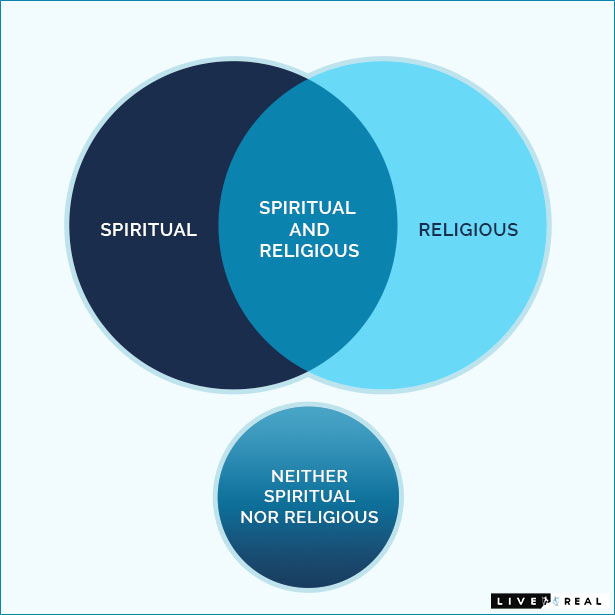
That’s a “dilemma with four horns,” or “quadrilemma,” or the “Maybe it’s time for some doomscrolling?” option.
We’ve mapped several advantages and disadvantages of the different routes, here and here.
There are good reasons to get clarity on all this.
For starters, the Nones/SBNRs now make up roughly one-third of all American adults (as of 2026).
Secondly, the number of Nones has been growing rapidly for decades. (The growth recently started leveling off.)
Third, reality is often very different from our ideas about reality. The category of Nones, for example, encompasses a wide range of profoundly different types, such as
* casual to serious yoga practitioners
* folks-who-don’t-quite-make-it-to-church/mass/temple-but-are-sympathetic
* cosmopolitan intellectuals (Alan Watts, for example)
* meditators who do it mostly for the physical/mental/emotional benefits
* near-monks who are quite serious about it, but don’t necessarily have an allegiance to a specific tradition
* and so on.
Fourth, once again, there might be ways all sides could benefit from friendly, good-faith, “let’s get to the bottom of this” encounters with one another.
But how?
Maybe what we need is…a good story?
There is a story that sheds light on some of these issues.
It was written over three centuries ago – but in some ways, it could have been published this morning.
It’s Pilgrim’s Progress by John Bunyan.
It’s one of the most popular books of all time. Some say its popularity is second only to the Bible itself.
The basic story goes something like this.
There’s a man named Christian.
He lives in a little town named “City of Destruction.”
(Side note: Tourism in the town had been off lately for some mysterious reason. Concerned citizens claimed the town’s name might have something to do with it. The mayor and city council formed a task force, several committees, and multiple subcommittees to study the problem. After many months, the mayor and town council declared that the data was inconclusive, further research was needed, voted to revisit the matter the following year, and gave themselves raises.)
(Additional side note: the above wasn’t actually part of Bunyan’s story. It was entirely made up here.)
Back to the real story.
Christian becomes convinced that dark times are ahead for the city.
He reaches the conclusion that the city, and everyone in it, will eventually be destroyed.
And he decides to leave.
What does that “mean”?
One way to interpret Christian’s decision is to say that he “realized his own situation.”
But here we might notice something interesting.
It’s our situation, too.
We all live in “City of Destruction.”
City of Destruction could also go by the name of “life.”
The human condition consists of facing “old age, sickness, disease, and death – the way of all flesh.” We’re all mortal. Life ends. Everything we see is impermanent. We all know, on some level, our eventual destination. But this knowledge can be so terrifying that we often live in denial of it.
Ernest Becker described this vividly in his Pulitzer Prize-winning book The Denial of Death.
But denied or not, it’s both real and inevitable.
Christian’s basic realization was correct.
Life can sometimes seem like a game of chasing an elusive happiness, full of struggle and suffering – even seemingly meaningless suffering – and with a terrible ending.
George Gurdjieff described it this way: it’s as if we live in a prison, on death row, with no hope of parole.
Some focus on making the prison cell as comfortable as possible.
Christian, however, decides that the only sensible thing to do is to try to escape.
And so, he embarks on a Quest.
He leaves City of Destruction.
Christian’s journey mirrors the story of Buddha, who also suddenly realized his very similar “situation” and, as a result, decided to search for some sort of answer.
At this point, Pilgrim’s Progress becomes an epic adventure of sorts, with drama, action, and maybe a bit of Indiana Jones (if Indie were a theologian on a quest for better theology).
In the tale, Christian makes friends and enemies. He encounters companions who help and even rescue him, and others who lead him astray. He fights monsters, battles demons (both inner and outer), and nearly comes to a bitter end several times.
At one point, he gets stuck in a bog and nearly drowns.
It was the “Slough of Despond.”
(Tourism at the Slough had been off recently as well.)
The Slough represents the load of guilt, anxiety, despair, and misery we all get bogged down with in life when we stop trying to escape into distractions.
He journeys through a stretch of rolling hills (the “Enchanted Ground”) where the air makes travelers drowsy. It represents stages where an intoxicating kind of spiritual “high” can lead seekers off the path.
He’s captured and trapped by a giant (named “Despair”) who locks them in “Doubting Castle.”
He battles a monster named Apollyon.
Apollyon represents the sum of all the forces that oppose Christian on his journey. He hurls fiery darts at Christian in a prolonged combat.
And so on. Throughout the quest, Christan struggles with fear, doubts, forgetfulness, his own bad decisions, peer pressure, guilt, rejection, humiliation, intoxicating pleasures, dead-end paths, misleading statements, false promises, mortal dangers, and more.
Amid this, he learns about a destination called “Celestial City.”
It’s the solution he longs for. It promises relief from his suffering and seems to offer real and perfect happiness.
The tension keeps rising until it builds to a climactic finale.
(Is it possible to spoil a book that’s over three centuries old?)
(If so: Spoiler Alert.)
Christian eventually reaches the River of Death.
With help from his friend (named “Hopeful”), he manages (barely) to keep his head above water. He arrives at the Celestial City and is welcomed in.
Here, we can revisit our original topic.
What can this reveal about the modern spiritual scene?
At risk of stating the obvious, Christian’s story is an inner journey.
Pilgrim’s Progress is an allegory.
Christian’s physical journey represents the spiritual odyssey a person can embark on to reach the actual “Celestial City,” enlightenment, awakening, salvation, union with God, etc.
It could be described as a psychological transformation.
-or, a series of psychological transformations.
The entire adventure takes place within the mind or soul of a person.
“Everyone is a mystic” in this sense, and we could describe Pilgrim’s Progress as illustrations of a series of spiritual experiences leading up to the “ultimate” spiritual experience.
Christian wasn’t sitting in church during all of this. He was on a quest.
Given this, Christian could be described as “Spiritual but Not Religious.”
But that isn’t the whole picture.
The other side also has a strong case.
Pilgrim’s Progress clearly takes place within a specific context.
That context is Christianity, and the culture of Christendom.
Christian’s life philosophy or worldview was theism.
And that life philosophy took a specific form.
Pilgrim’s Progress didn’t take place in a cultural vacuum. Bunyan’s version was packed full of Bible verses and references to the Old and New Testaments. (Of course, there have been remakes with the theology stripped out. “Let’s remake Raiders of the Lost Ark, but you know, without all the archaeology stuff. Let’s do Jurassic Park, but without the dinosaurs.”)
In that sense, the case appears to have reversed.
Pilgrim’s Progress seems firmly on the side of Organized Religion.
But there’s another twist, based on a critical difference.
There’s a key distinction that warrants highlighting.
Not everyone on the side of Organized Religion has taken this journey.
Again, Christian is describing a series of firsthand, direct, subjective experiences.
Not everyone goes through those experiences.
In other words, some individuals “live” in City of Destruction, and never leave.
It’s even possible to imagine someone who lives in City of Destruction, is kind to their neighbors, pays taxes, goes to church, is nice to puppies, lives as a “good person,” and so on.
That individual could be respected, well-liked, and a good, dutiful citizen – yet never leaves in search of the Celestial City.
This factor seems to put Pilgrim’s Progress back on the side of the Nones.
Does that finally settle the question? Does Pilgrim’s Progress finally land on the side of the Spiritual but Not Religious?
No. (The twists still keep coming.)
There’s yet another episode that really drives the point home.
The story doesn’t end with Christian reaching Celestial City, being lifted on everyone’s shoulders, cheers all around, and heading inside.
It ends on a darker, more sobering turn.
After Christian and his companion Hopeful have been welcomed in, another traveler approaches the gates.
That traveler also reached Celestial City.
Naturally, he wanted to enter.
No one expected him, so no one came out to greet him.
The traveler knocks at the gate and speaks with the men who answer. He explains, in so many words, that he’s arrived, that he’s a good person, that he’s paid tithes, given alms, kept the commandments “as well as any,” and so on.
The men at the gate ask for his certificate.
(The certificate was given to Christian early in his journey, at the Wicket Gate.)
The traveler doesn’t have it.
This might give the impression that Bunyan was on the side of Organized Religion – that you need a specific certificate, issued by a specific authority, in order to pass.
But that still doesn’t settle the matter.
The men ask him other questions, and he doesn’t have answers.
The traveler’s name is “Ignorance.”
(Ignorance’s mother was probably paid a visit from Child Protective Services at some point. “Umm, why did you pick that name for your child again?”)
Christian had already encountered Ignorance a few times during his travels.
There were key differences in their respective journeys.
For example, Ignorance didn’t pass through the Wicket gate where the certificates were handed out.
Instead of crossing the River of Death on foot, as Christian and Hopeful did, he hired a boat (steered by a character named Vain-glory). (Parents’ naming conventions don’t come across really well in this tale.)
Through much of the rest of the journey, Ignorance lagged behind the others. In conversation with Christian, Ignorance came across as hard-headed, stubborn, and arrogant.
All to say, Bunyan portrays this character as nominally “religious,” outwardly respectable, seemingly fine on the surface, yet opposed to genuine self-knowledge, genuine humility, and psychological transformation.
In other words, he portrays Ignorance as Religious but not Spiritual.
Pilgrim’s Progress ends with Ignorance being turned away from Celestial City.
There’s a final twist involving the author himself.
John Bunyan wrote The Pilgrim’s Progress while in prison.
What was his crime?
Preaching without a license.
Bunyan himself was a “nonconformist” Puritan.
(If trophies were awarded for words that don’t fit together, this combination might be heavyweight champion of the world.)
Bunyan was arrested and charged because he refused to stop preaching at “unauthorized religious meetings.”
His initial jail sentence was supposed to be short.
Yet he refused to say he would stop preaching.
As a result, he eventually served twelve years.
Bunyan himself resisted narrow denominational labels.
In his day, he was probably considered Spiritual but Not Religious.
What's the takeaway from all this?
When it comes to the Spiritual but Not Religious debate, we can draw a few clear conclusions from all this:
* No mere category solves the problem.
* The answer isn’t simply one or the other.
* When it comes to the Nones and the Organized Religious folks, both sides have good and bad apples.
* Being “organized” doesn’t necessarily make something “good,” and being “independent” doesn’t necessarily make someone “bad.” And vice versa.
* Folks here can get along.
* Going Spiritual but Not Religious, or DIY religion, can be risky. Since only one person is prosecutor, defendant, judge, and jury, with no guaranteed, built-in reality checks, it’s possible for individuals to pin a hundred medals on their chests and declare themselves enlightened, all-knowing Emperor of the Universe, all in their imagination. A key point of “Know Thyself” is that it’s easy to “Fool Thyself.”
* Going “Organized Religion” can be risky, also. In this business, “safety in numbers” isn’t a thing. A religion might be “organized,” but that organization also might have become dry, lifeless, misguided, or led by individuals who are confused, mistaken, or corrupt. Merely being part of a group doesn’t mean that group is heading in the right direction. History provides an abundance of evidence here.
* The ideal route seems to be a paradox in the sweet spot between extremes that encompasses the best of both worlds: an organized community that is sane, based in reality, rich with genuine spirituality, and full of individuals who are making the solitary journey from the inner City of Destruction to the inner Celestial City.
This might all seem a bit nuanced.
But finding the “sweet spot” can sometimes take some calibration.
And answers that aren’t bite-sized, shrink-wrapped, and able to solve problems in five minutes or less are a bit out of style these days.
So be it. Sometimes a book that’s over three centuries old can offer better insights than a slick new multi-million-dollar Silicon Valley gadget.
And in matters this important, they deserve that rare commodity of attention.
After all, we’re all mid-journey, right now, to some destination.
Whether we believe that a moment will come when we’re knocking on a pearly gate or not, we can be fairly certain that, sooner or later, we will be crossing some sort of Great Unknown River.
Knowing that, it can seem worthwhile to find some good maps.
Peace to the Wanderer.